
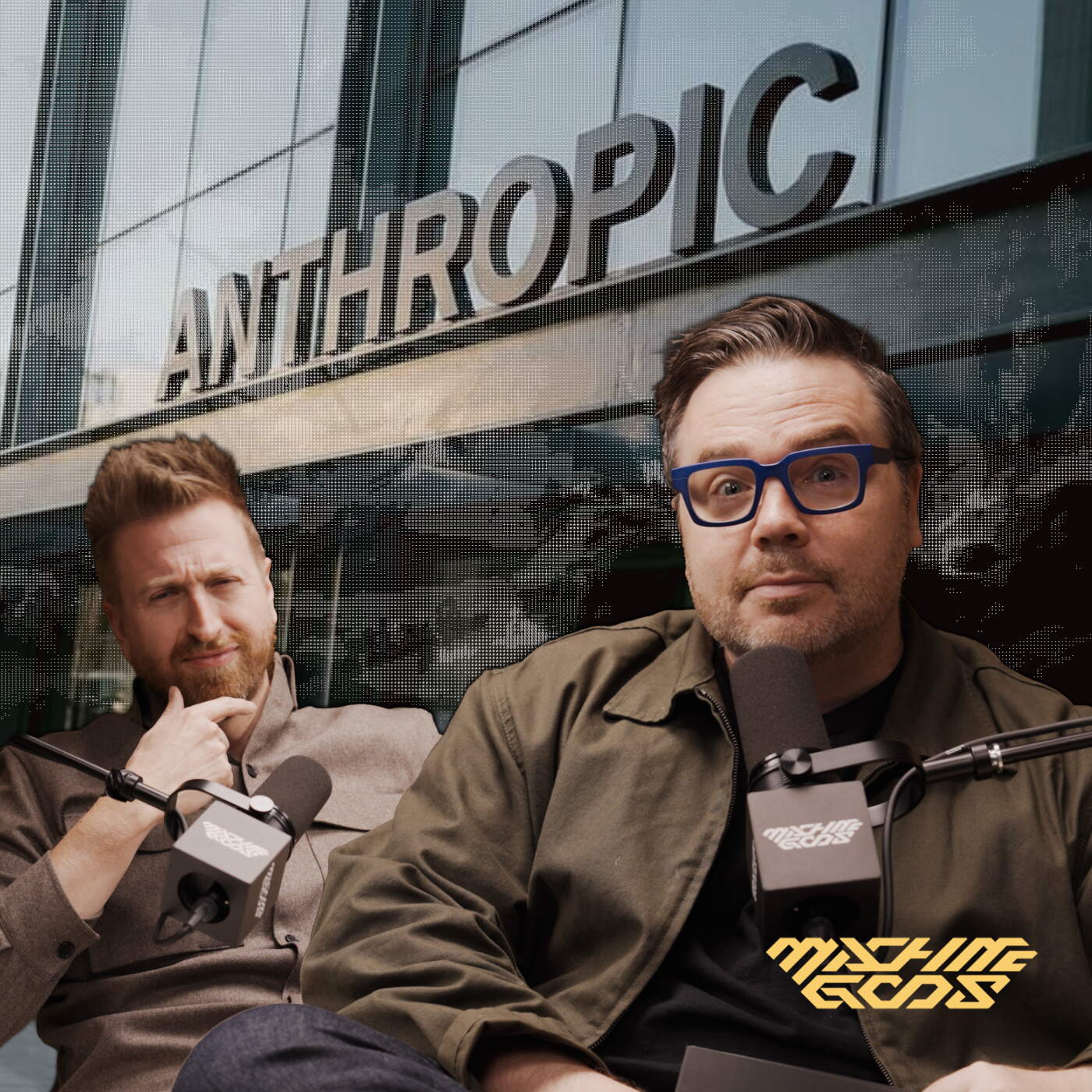
Kevin Roose: What are our biggest takeaways from Anthropic's record IPO?
Casey Newton: Will the company prioritize safety now that it answers to Wall Street?
Roose: What did the two of us get wrong about Anthropic back in 2023?
Newton: And why is Kevin so afraid of Madison Huang?
Roose: I'm Kevin Roose.
Newton: I'm Casey Newton.
Roose: And from San Francisco, in partnership with NPR, this is Machine Gods.
Newton: The official podcast of the singularity starts now.
Roose: Casey, it is the morning of the Anthropic IPO, one of the most awaited events in all of technology and business over the last year. It has happened. I just saw the video of Dario Amodei and his co-founders ringing the bell at the Nasdaq, a pretty surreal event here in San Francisco, and we should talk about it.
Newton: Yeah. Today is a day where my personal and professional lives are colliding into one another at 100 miles an hour like something out of Grand Theft Auto VI, Kevin, and I'm excited to talk about it with you.
Roose: Yeah, so we saw the shares officially start trading on the Nasdaq under the ticker symbol ANT. The starting price was $83 a share. It popped to over $111 a share and sort of is settling in the kind of low hundreds. We'll see where it ends up. You know, it's sort of a sucker's gamble to try to predict where these things are gonna go—
Newton: Well, we always say is—
Roose: On the first day of trading.
Newton: What we always say is never get the stock prices from a podcast.
Roose: Yeah. [laughs]
Newton: We say there are better tools available to you, and you should use them.
Roose: That's true.
Newton: Yeah.
Roose: But it does make Anthropic one of the largest companies in the world, a valuation somewhere in the sort of $1 to $2 trillion neighborhood, the biggest IPO in history, and the first major frontier AI lab to go public.
Newton: Yeah, lot to talk about here. This probably a great time to mention that my fiancé does work at Anthropic, and you can see my full ethics disclosure at platformer.news/ethics.
Roose: Yes. And you— if you wanna meet Casey's fiancé, he's down at the Lamborghini dealership kind of checking out the options today.
Newton: Hey, they're— they have a great sales event every November.
Roose: [Laughs] It's called Black Friday?
Newton: It's always Black Friday, Kevin.
Roose: [Laughs] So let's talk about this. You know, I've covered a lot of IPOs in my career. You have, too, I'm sure. And it's this weird kind of celebration of capitalism mixed with kind of, you know, the ability for the public to either buy or sort of bet against the shares of a company. This is, I would say, the most unusual IPO I've ever covered, not just because Anthropic is, you know, going public at this enormous valuation, but because this is a company that also has deep, grave concerns about the technology that it is building and selling.
Newton: Yeah. It's a weirdly apologetic IPO. You know? Like, not that the actual executives at Anthropic are apologizing for it, but when you read the public sentiment from people who work there, they are sort of continuously reminding us that they're extremely worried all the time.
Roose: Yes. And actually, before ringing the opening bell, Dario did give some remarks where he, of course, emphasized what he called the very real risks of the technology, from misuse by individuals and nation-states to economic disruption to losing control of AI systems. Not the kind of thing you typically hear at a Nasdaq bell ringing. But he also did express excitement about the technology, the sort of vision that he has for AI that will cure disease and usher in this kind of enlightened age. I'm curious what you made of the sort of balance between optimism and doom over there today.
Newton: I mean, it was basically Dario's stump speech. I saw it on X early this morning and sort of was scrubbing through it with my finger, and it was like, "Need to take risks seriously," scrub, scrub, scrub. "Could usher in age of miracles," scrub, scrub, scrub. Right? Just, like, the sort of stuff we have heard from them forever, and I think it just illustrates the way that he has to walk this fine line between trying to get investors excited about his stock while reminding us that he thinks that we're on very dangerous ground.
Roose: Yeah. So we've talked a little bit about the implications of this IPO for the customers of Anthropic, the employees of Anthropic. Obviously, it's one of, if not the biggest day of sort of personal wealth generation that this city has seen in a very long time.
Newton: Oh, I mean, ever.
Roose: Ever.
Newton: Like—
Roose: Since— I was gonna not judge the Gold Rush. I was thinking maybe the Gold Rush, there was a day when, like, they—
Newton: Well—
Roose: They hit a really big pile of gold.
Newton: Here's the thing. Money used to go a lot further back in the 1800s. By today's standards, one of those little lumps of gold would barely get you a one-bedroom apartment in San Francisco, Kevin.
Roose: That's true.
Newton: Yeah.
Roose: [Laughs] That's true. So we're not gonna rehash all of that, but there are a couple new wrinkles that I did want to discuss with you. One is that the philanthropists and the investors who are supporting Anthropic, many of them are very excited that they're finally seeing this big milestone of the IPO. But one of them is very reluctant and feeling very conflicted about this. This is Dustin Moskovitz, who is a co-founder of Facebook, also ran Asana for many years and was very influential and bankrolled much of the early AI safety movement. He's been affiliated with effective altruism. He was an early investor in Anthropic, and he came out with a statement today to Teddy Schleifer at The New York Times, where he was basically saying, like, this— I feel very conflicted about this, and I don't think Anthropic should keep racing toward recursive self-improvement. I think it's dangerous. And he sort of expressed some regret about his role in all this. What did you make of that?
Newton: Look, Dustin is a really smart and thoughtful guy, and I think people should read the statement. He is a very farsighted individual. He truly did see a lot of this coming, and he clearly has some regrets now that the investment that he made in Anthropic, which he saw as an organization that was gonna be devoted fully to safety, to turn around and today see it one of the world's largest public companies leading the frontier of AI development, increasingly using elements of recursive self-improvement. It seems to me that he's having this feeling of, "This is not what I signed up for," and I think Dustin is among a quickly growing group of people who are saying, "Hey, this whole recursive self-improvement thing, we need to get a handle on this. We need to stop it right now."
Roose: Yeah, and there's actually a rally going on at Anthropic's headquarters today, timed with the IPO, where a bunch of safety advocates and others who are concerned about this RSI direction are going to essentially gather and urge Anthropic to slow down or stop what they're doing.
Newton: Yeah.
Roose: Very unusual for an IPO to be greeted with this much ambivalence by people outside the company, but also by some people inside the company. I've been talking to some folks at Anthropic. I'm sure you have, too. I would say some of them are counting their money, and they're very happy with how things are going. Others of them are feeling quite nervous about this.
Newton: The only thing I could liken it to is that when Airbnb had its IPO, and I went down and protested because of the cleaning fees that they were charging at the time. And I said, "This is dangerous, and I don't like the way that it's headed." But it was a pretty small protest—
Roose: Pretty small rally—
Newton: As these things go.
Roose: Just you and one—
Newton: Yeah.
Roose: And a bullhorn.
Newton: Mm-hmm.
Roose: Let's talk about The MisAnthropic Statement.
Newton: Mm-hmm.
Roose: Did you see this?
Newton: I did. Now, I was confused about this because I thought that Misanthropic was the company's annual drag pageant.
Roose: [Laughs]
Newton: But you told me that it's something different.
Roose: [Laughs] No.
Newton: Yeah.
Roose: This was an open statement that was signed by a lot of notable people in and around the AI industry. And I'll just read the statement in its entirety. "Anthropic warns that recursively self-improving AI could concentrate power and escape human control, yet races to build it first. The company uses safety branding to court investors, employees, and the public even as it has quietly weakened its safety pledges and lobbied for self-serving regulation. Anthropic is not a safe AI company, and we must reject its reckless attempt to amass power in the name of the greater good." Signed by a truly strange list of bedfellows, including AI skeptics like Gary Marcus, accelerationists like Guillaume Verdon, Based Beff Jezos, the head of the accelerationist wing of the AI movement, and some AI safety folks like Nate Soares of MIRI. What did you make of this statement?
Newton: You know, as we have talked about on the show many times, people are worried about recursive self-improvement. Anthropic itself in its public statements says that it is worried about it as well. So I am glad that people are taking the moment of the IPO to focus on what is truly the much more important and larger question, which is what happens in a world where the AI is very rapidly improving itself given what we know about the challenges in aligning these systems to human values.
Roose: And what are you looking at just on a purely financial level from the Anthropic IPO? You know, for a lot of people, this IPO is something of a referendum on is the AI boom a bubble?
Newton: Yeah.
Roose: And are we going to see these sort of inflated valuations attached to these companies that will then crash to Earth once they, you know, run into bottlenecks or once the models stop improving?
Newton: Yeah. So I mean, one of the biggest debates in AI over the past three or so years has been to what extent is the demand real, and to what extent can these companies ever be profitable? I think investors were surprised when the Anthropic S-1 came out that at the level of inference, so actually, like, serving you a query via Claude, Anthropic was making great money. It had a very high profit margin. And so I think the pop that you saw in the stock price today shows you that there are a lot of people out there that wanna make a long-term bet that there just is going to be a lot of value in this. So I do think that if you're of the sort of variety of skeptics who has been saying that all of this is fake and it's all about to get, you know, washed into the ocean like a crypto scam from 2021, today is gonna be a hard day for you.
Roose: I think so, but I also wanna point out in the interest of skepticism and journalistic due diligence that it is frequent that a company will pop on IPO day. Their stock will go up 50 or 75 percent, and that will be the high-water mark.
Newton: Yes.
Roose: It only goes down from there.
Newton: Yes.
Roose: So I think there are a lot of exuberant investors who have been waiting a long time to sort of bet on AI in some tangible way. Now they have the first frontier lab that is sort of a pure-play AI bet, and they're doing it. And so far, you know, who knows where it'll close today, but so far the reaction seems to be pretty good. But I would also just caution that there are many examples in history of this being about as good as it gets for a company.
Newton: Yeah, I mean, to that point, it— something I love to remember is that Facebook had a terrible IPO. It was, like, mired in shareholder lawsuits for years afterward because of just, you know, various little irregularities and things didn't go great. How much did that matter to Facebook's future? Didn't matter at all, right? In some very real sense, the IPO day did not matter for Facebook. The same might be very true for Anthropic. At the same time, Kevin, this is one of the primary engines that keeps Silicon Valley going, right? Venture capitalists step up. They take crazy bets on companies that barely even want to be companies, in Anthropic's case, and yet just a few years later, they're able to earn this massive return and pump it back into the ecosystem. So that to me is what is actually important here, that plus giving the public some exposure to the upside of AI, assuming that there is any.
Roose: Yeah. I will just say it's notable to me that the rest of the stock market, or a lot of the rest of the stock market, is down today even while Anthropic shares have been popping. And to me, like, I don't know that this is literally true, but it seems sort of spiritually true that if you're long Anthropic, you're kind of short the rest of all companies on Earth because this thesis that, like, AI is going to replace humans as sort of the fundamental substrate for intelligence in the economy, like, that is a bet that is very good for Anthropic if it's true, but maybe not so good if you're just a regular company and you're out there doing things the way you've been doing them.
Newton: Yeah, absolutely. I do agree with you that a bet on Anthropic is essentially a bet on the idea that the company is going to be able to automate large portions of labor and that companies will be purchasing Claude tokens in a sort of substitutive way for hiring real people. And so that's the bet that they're making. On the stock market today, though, Kevin, my understanding is just that chip prices are going way down because of various government investigations that are going on, and there are questions about circular financing. But I retain full confidence in Nvidia CEO Jensen Huang to figure this out. [laughs] What's that guy up to today?
Roose: You know, I keep meaning to look.
Newton: [Laughs] All right. Well, when we come back, we have more to say about the Anthropic IPO based on our years at this point of covering this company, and how unexpected it is that we are at this moment at all. All right, Kevin. Well, there went a lot of facts and figures about the IPO. But for this next segment, we wanted to open up our reporters' notebooks because both you and I have been following this company for about as long as any other reporter. We both first went into the company's offices in 2023, before I met my fiancé, by the way, and we learned a lot about the company in that year. Some things that we came to think about that company I think are still true today. Some things I think we got very, very wrong in ways that are interesting to talk about. So I wanna get into that, and then I just also want to get into how we are feeling in this very strange moment where on one hand we have a big business IPO that's leading to lots of excitement and questions, and on the other hand, we have this sense that maybe we really are entering into the singularity for real, and all of the risks that that is bringing into the conversation.
Roose: Yeah, I think every IPO is kind of a chance to— it's almost a rite of passage, right, where you have this chance to kind of reflect on the path that led this company to the point where they're going public. And often I think that's not an interesting exercise [laughs] because most companies are very boring.
Newton: Yeah.
Roose: But in this case, I think the question of, like, what is Anthropic as a company, as a business, as a collection of people? I think it is very misunderstood. I think a lot of people are sort of projecting their normal company sort of templates onto what I think you and I both agree is a very unusual company with a very unusual mission.
Newton: So I wanna get into this, Kevin, because you were one of the earliest reporters to take this company seriously. You wrote a really long and great profile of them for The New York Times in 2023, and I'm curious if you have revisited any of your notes from that time, and what stands out to you now about the company that you knew then and how it changed, and also just what your initial impressions were, and whether any of those were notably right or wrong.
Roose: Yeah, so I went back in my notebook this week to the interviews that I did for that piece in— I think some of the interviews were in April, somewhere in May of 2023, and it was fascinating, right? 'Cause I feel like as reporters, we are constantly making these sort of little bets, and they're not financial bets. It's not like I'm gonna invest money in this company and hope it succeeds. It's like I'm betting that this company will be important.
Newton: It's a relevance bet.
Roose: That— Yes. And I'm betting that people in the future who want to understand something about this company will, like, need some kind of definitive take on it. So anyway, that was a good bet that I made. I'll tell you what was a little humbling was I am shocked at how many scoops I just had in my notes from 2023 that I just sat on and did nothing with. [laughs]
Newton: [Laughs]
Roose: I was like, they told me during these interviews that every Anthropic co-founder had the same amount of equity. I completely forgot that and reported it as if it were new information when we analyzed the S-1 the other day. They told me their long-term compute strategy was to play Google and Amazon off of each other. [laughs]
Newton: [Laughs]
Roose: I was like, "Hmm, that sounds fun." I mean, at the time you have to understand, like, this was not a real company.
Newton: [Laughs]
Roose: They had 150 people. Their office was this cramped little space in Jackson Square. Like, there was no security. It was just kinda like you take the elevator up, you walk in. They—
Newton: I mean, in terms of, like, the product, like spring 2023, this is, like, sort of very early version of Claude, and usage was probably a rounding error compared to ChatGPT.
Roose: Yeah, so the thing I was there to report on was the development and launch of Claude 2, which was their first real public model. They had put Claude in an API, so, like, they— [laughs] It was very funny. There was one time I was talking with Daniela Amodei, and she kind of says in a kind of proud way, "We have hundreds of businesses using Claude through the API," [laughs] which now obviously is so tiny compared to the number of businesses. But at the time, that was something to brag about.
Newton: Yeah.
Roose: They were getting ready to launch Claude 2 as a chatbot because ChatGPT had just come out the sort of winter prior to that. But they were only making Claude available at that point in Slack, Poe, and the API. They—
Newton: Poe, the sort of Quora founder's, like, multi-chatbot product.
Roose: Yes.
Newton: Yeah.
Roose: So there was no iOS app, and they hadn't yet decided whether or not they were gonna charge for access to Claude yet. So a couple things stuck out to me in going back through my notes. One was I was very struck, even at the time, by how sincerely panicked everyone was about AI. I'll just read you some lines from my notes that I took following my first visit there. "There is nothing fake or cynical about Anthropic's agita. They are quite simply the most worried company I have covered. I have never encountered a group of people that so badly needed a Klonopin."
Newton: [Laughs] Which is so interesting because, of course, in 2023 that was risible, right? Like, you're afraid of Claude 2? Be serious. And yet, fast-forward to 2026 when we're having a fresh outage every day in a new part of the internet for reasons that do seem AI-related, and all of a sudden the panic doesn't seem so silly.
Roose: Yes, and I was somewhat skeptical. You know, my piece, they— it called Anthropic the white-hot center of AI doomerism. I thought there was a chance that they were just kind of being neurotic about something that would turn out to not be so scary. Now of course, I know that I was wrong and they were correct to worry, albeit early. The other thing that really stuck out to me as I was going back through my notes is I was very skeptical of Anthropic's prospects as a business.
Newton: How skeptical were you, Kevin?
Roose: So I talked to everyone there, including, at the time, their one business guy who was sort of in charge of the entire business side of the company, and I was going back through my interview with him. He said that basically the business team at Anthropic, which at the time was, like, him and maybe one other person, essentially serves at the pleasure of the research team. [laughs]
Newton: [Laughs]
Roose: He said, quote, "We need to make the money so they can do the work to, like, save the world."
Newton: Right.
Roose: So essentially, the business was very much an afterthought. They just needed to make enough money so that the research team could continue doing their thing.
Newton: The tail was wagging the dog here.
Roose: [Laughs]
Newton: Very unusual setup.
Roose: Exactly. And I wrote in my notes, "They have to make money, but they seem to be doing it begrudgingly." And then this is the line that really makes you believe that I have no future in venture capital: "I do not know why you would invest in a company like this." [laughs]
Newton: [Laughs]
Roose: They are so worried, they are going to optimize not based on what will make money, but what they can stomach.
Newton: You know, it's so funny because saying you have no future in venture capital, it's true, and for this reason. Ever since I got to this town, what the VCs always say is that the best investments look like the worst ideas, right? And if you want to make money in this business, you sort of have to bet on the stupid thing. And man, will Anthropic be an all-time case study for that phenomenon.
Roose: Totally. So I was unimpressed by the business, but I was impressed with their seriousness about AI safety and the mission. I felt like this was a very unusual company culture. Everyone I talked to, no matter what division they were in, like, was sort of obsessed with this question of AI safety. I wrote in my notes that they are, quote, "a little weird, but in a Good Will Hunting way, not an American Psycho way." [laughs]
Newton: [Laughs]
Roose: Whatever I meant by that. And it just seemed to me like this collection of incredibly smart, incredibly farsighted people who were very neurotic and desperately wanted to avoid messing up or doing anything wrong. They had gone through this sort of traumatic bonding experience of, like, they leave OpenAI together, they start this company. ChatGPT comes out. It's like their biggest competitor, their former employer, like, sort of bursts onto the scene. Then, it's easy to forget, their biggest investor gets hauled off to prison, as—
Newton: Sam Bankman-Fried.
Roose: Sam Bankman-Fried. So they are in this sort of— this period where they are near death, and that's— I didn't know it then because they were projecting sort of confidence and optimism, but this was a company that was sort of, like, on the brink of collapse.
Newton: Yeah. And one of the things that you write about in your book is that this was a company that from the outside should have died several times.
Roose: Yes.
Newton: Right? And that that was felt within the company, and that the company itself was surprised that it did not die on a handful of occasions over the past few years.
Roose: And let's talk about why it didn't die. Because I'm curious if you have thoughts on what, if any, kind of lessons we can learn from looking at the brief but spectacular history of Anthropic.
Newton: Yes.
Roose: What is it about them that allowed them to succeed and now to go public?
Newton: Well, here is another choice that they made that I would put in the category of looks bad but turned out well, which was essentially they put all their eggs into one basket, which was in scaling large language models, right? By now, listeners to the show will be familiar with the scaling laws, the idea that you sort of pour enough data and compute into a model, and you apply a lot of reinforcement learning to it, and the models get smarter and more capable over time. Everybody knows this formula, but all of Anthropic's competitors, Kevin, really kind of hedged their bets here, right? OpenAI had a big robotics division. Google got curious about world models. And that seemed very logical to me at the time, right? Make a portfolio of bets, right? And sort of see which one of them paid off. What we see in the story of the Anthropic IPO is they put all of their eggs into one basket, and it has just worked the best out of anyone's idea. And I have to tell you, Kevin, I find it so counterintuitive because it is almost mystical to me, this bet that they are making, which is that by just sort of processing all human text, that there is so much information in that text that you can make something that approaches superintelligence. Again, it is not an idea I would have had, but it has created, it appears, more than a trillion dollars' worth of value.
Roose: Yeah, it really is true that their focus is what has set them apart from their rivals. I remember going there more recently last year and seeing people with, like, the scaling laws, like literally the math equations of the scaling laws on T-shirts.
Newton: Because they were afraid they would forget if they weren't on their shirts.
Roose: Right. [laughs]
Newton: Yeah.
Roose: Right. They were printed upside down. No, they weren't. But they were just, like, they were obsessed, monomaniacally obsessed with this idea of scaling as the key to basically all future forms of machine intelligence. And, you know, they have this list of principles at the company that I'm not sure if they've ever distributed or not, but one of them is, "Do the dumb thing that works." I think they've softened it since then to, like, "Do the obvious thing that works," or something like that. Because I think there was this tendency in AI research for much of the past decade to, like, overcomplicate things, to try to engineer these, like, very specific solutions to specific problems. And their philosophy, which I think is borne out, is just do the dumb thing that works. Just make the model bigger and trust that it will solve all of the problems. I'm curious if there are any other cultural things about Anthropic that you would highlight.
Newton: I mean, I think a very important part of their culture is Dario Amodei, who is perceived as a visionary figure within the culture. Every couple of weeks, he gives a talk that was initially called, somewhat jokingly, Dario Vision Quest, but increasingly, Kevin, that just seems like less of a joke. He really is selling this mystical vision of a near-term utopia, and is telling employees that they are sort of all in it together and in the fight of their lives to make sure that superintelligence goes well. There is just a religious aspect to this company that is incredibly unusual. I think it has often been the goal of many Silicon Valley founders to have something like this. Like, I think Brian Chesky would kill to have a company where all of his employees felt the religious mission of letting you stay in somebody else's house for a couple nights. It's just very hard to pull off, right? But with [laughs] with AI and superintelligence, you have just sort of found this mission that has attracted some incredible talent, right? Anthropic has famously great employee retention. For what it's worth, I think it is sort of a mixed bag. I think when you have a religious passion for something, it can lead you down some very dangerous roads. But I think that is another sort of singular thing about this company. I think that, you know, OpenAI has its share of missionaries as well. I think Google has many fewer of them. But I think the highest concentration of them is at Anthropic, and I do think it's been hugely helpful to them.
Roose: Yeah, and they spend a lot of time and effort trying to keep that culture alive, even as they are growing like crazy. Jack Clark, one of the co-founders at Anthropic, gives a talk to new hires called Anthropic Is Not a Normal Company or something like that. And I think it is part of their struggle, part of their worry about going public and expanding so rapidly is that that culture will kind of dilute and more people will come in who are maybe just looking for a, you know, a quick buck or just looking for a prestigious job, who are not bought in, and they'll say all the right things, but then when it comes time to it, their alliances won't be, you know, in line with the rest of the company. I've been reflecting on this initial impression I had that this was a company that was not going to run itself like a business. I think in some sense I was obviously wrong. They've proven to be very good at business, to a degree that I think has surprised even some of their co-founders. At the same time, I still think this is a risk that investors are not adequately pricing in. This company is very ambivalent about capitalism and being a company. They are liable to do something that is extraordinarily harmful to the value of their stock. In fact, they have in some sense been sort of preparing to do something like that for a long time.
Newton: Oh, I mean, look at the fight with the Pentagon earlier this year. That was absolutely a value-destroying move, at least in the short term, right? Like, I think that's what sort of, like, the smart money would have said is, "Look, if you're gonna provoke a fight with the U.S. government over this contract negotiation and give up who knows what other business," the company is still designated a supply chain risk while also famously being designated a national champion. But given that designation, you know, that could prevent them from making money in certain ways. But yes, of all of the labs, I do think, you know, like, I could actually imagine a moment where Dario was like, "You know, Claude has become too dangerous, like, switch it off, and we don't care what that does to the stock price."
Roose: Yeah, shut down the company.
Newton: Yeah.
Roose: Or, you know, we're only gonna do internal research and we're not gonna ship products anymore. Like, I'm not saying that's going to happen, but that was part of the sort of S-1 that I didn't see was, you know, it's all about the risks, and there are many, many dozens of pages about all the things that could go wrong for Anthropic as a public company. But this central tension that I think I identified, like, three years ago, is still there. Which is, I think the people running this company have an allegiance to a set of principles that is different than what they are now duty-bound to say as officers of a public company.
Newton: Yeah.
Roose: It'll just be very interesting to see how that plays out.
Newton: It will. I mean, my perception has been that a reason that they want to go public, Kevin, is to give the public some exposure to something positive out of AI, right? Like, they understand that a lot of the negative externalities of AI have been front-loaded, and that it is causing harm in people's lives, and people don't have a lot of reason right now to believe in utopia. But, you know, if you buy a share of Anthropic stock and it goes up, maybe that buys them a little bit of goodwill at a time when the industry could really use some of that.
Roose: Yeah. So Casey, how are you feeling about the Anthropic IPO now that we've talked through all the facts and figures? Because I know this is an unusual situation for you as a journalist and also as the partner of someone who works at Anthropic. So how are you processing all this?
Newton: It's been extremely weird. What it has made me realize is that mostly in my life I don't make any meaningful distinction between my personal and my professional life. I just wake up and I be myself. I cannot do that in the Anthropic situation because my reaction personally and professionally are very different. Personally, I'm thrilled for my fiancé. He's been obsessed with AI for as long as he can remember. He worked very hard. He is going to be very fortunate as a result. That is awesome for him. It will affect our lives in some meaningful way. Now, we keep our finances separate. We are still not married. See my full ethics disclosure at platformer.news/ethics. But I do think this is just gonna have a very meaningful effect on my life that will be a positive effect. And so that is kind of how I relate to it personally. Professionally, though, it's what Jeff Bezos used to call a complexifier, Kevin. You know? Like, people— He used to say this about owning The Washington Post, that it just kind of, like, it created some, like, unresolvable tensions in his life. That is how I feel about marrying somebody who is in the AI business, right? A fact about me is I met Dario Amodei before I met my boyfriend, right? I was also in meetings with the company in 2023 and getting to know them and forming my thoughts about them. And my hope was that I could continue to cover it the way I cover any other company, sort of without fear or favor, without feeling sort of, like, tied to any outcome that they may or may not have. So this is just a complicating thing for me, and I will rely on you and all of our listeners and viewers to just let me know if I am, like, falling short of my goals as a journalist, which is to be objective and tell you as close to the truth as I know it.
Roose: We'll just put a little sound effect on the soundboard that has, like, a shill alert.
Newton: [Laughs] Yeah.
Roose: And every time if you're, you know, edging towards shilling for Anthropic, we'll just hit the shill button, and it'll make some sound effect.
Newton: I mean, please do. I mean, here's what I want people to know. I am— I want you to do this, right? Like, my goal as a journalist is to be a good journalist. And so if you think that I am, like, sucking at it, like, please let me know, and I will try to get better at it 'cause it is more important to me that I'm, like, good at that than, like, you know, you never hurt my feelings.
Roose: Yeah. For the record, I think you've been very upfront and forthright about all of your various conflicts. You've held the line very well. I'm feeling a couple of things. Like, I don't have a partner who works at Anthropic. I don't have any investments in them or any stake in the outcome here, but it is just strange to be a journalist who covered this company very early. You know, I think it's also important to note, like, they've been unusually gracious with their time and access to their people. There are not many companies in tech that have ever said to me, like, "Come into our office for two weeks. Hang around. Go to meetings. Talk to anyone you want to." And I think it reflects probably a savvy press strategy from them, but I think they're also just— This is one of the ways in which they are also unusual is that they have been very open to talking with people like you and me.
Newton: It's important to say they like journalists. They've always been very open to bringing us in, and I think that if you detect positive coverage around Anthropic in general, that is one of the reasons why. Not all of the labs are like this. And, you know, another thing about Anthropic is because they tend to take safety seriously, policy seriously, a lot of tech journalists do too. And so I do think there's been kind of a spiritual alignment between journalists and Anthropic that has generally resulted in more positive coverage for them. It's also probably resulted in some blind spots as well.
Roose: For sure. And I think the big question going forward is, like, what will Anthropic do now? What will they be incentivized to do by being public? Things are really heating up in AI safety, which is their core area of focus. And so, you know, I think the rest of the story remains to be written. I don't think the IPO is the last we'll ever hear of Anthropic. In fact, I think, you know, they'll probably become more central to the show that we produce and the topics we cover.
Newton: Let me toss out one more strange thing about this IPO moment, Kevin, which is the cognitive dissonance that you just have to experience when you are trying to contemplate simultaneously a trillion-dollar IPO and the prospect of catastrophe leading all the way up to human extinction, right? I don't think it's possible to have a coherent set of emotions about that. In fact, I weirdly feel the same about it as I feel about a nationwide ground stop that comes the day after a two-day Microsoft Outlook outage, you know, followed by the NSA private communications network going down. It's just, like, it's a very strange moment, and it reminds me of the first time I ever went into Anthropic's office, and there was a guy there who I was talking to, and there was a sticker on his laptop in 2023 that said, "This is the last normal year." And I thought, say what you will about [laughs] 2026 in this moment, it does not feel normal.
Roose: No, it does not feel normal, and I think you're right that there is cognitive dissonance of, like, we are treating this on some level like any other big business moment, right?
Newton: Yeah.
Roose: It's an IPO.
Newton: Yeah.
Roose: It's the ringing the bell. You know, we're watching the stock chart. It's, like, feels like we're watching any other company. And then the things we're talking about with respect to this company are, like, are they on the cusp of creating the recursive self-improving AI system that could end life on Earth?
Newton: Yeah.
Roose: And so I just don't exactly know— Like, I don't root for companies as a journalist, and I'm— But even if I were just a member of the public, like, I'm not sure whether I'm rooting for this company or not because I think a world in which Anthropic is a $10 trillion company is a world in which a lot of other things have broken.
Newton: Absolutely. I mean, like, I'm also not rooting for any company. I think if you're stanning any company, whatever your personal attachment is, like, you are making a mistake, right? Like, the things that I try to stan are, like, principles of good governance, democratic control, human oversight of complicated systems. That is what we need in this moment. And so in that sense, Kevin, the IPO is just arguably a distraction from much more important matters.
Roose: And please go to our merch shop to get your human oversight of complicated stickers.
Newton: Human oversight of complicated systems—
Roose: Human oversight of complicated systems—
Newton: The systems have gotten so complicated, they need human oversight. And in that, they're like AI.
Roose: [Laughs] Well, well, Casey, what have we here?
Newton: Well, Kevin, in an effort to lighten the mood after a tumultuous day, we thought we could once again open Pandora's box.
Roose: Pandora's box, the box famous for lightening the mood in ancient mythology.
Newton: Yes, that's right. [laughs]
Roose: Which we have turned into a comedy segment about the headlines of the week.
Newton: Well, why don't you go ahead and open up the box, Kev?
Roose: Let's open the box. Do you think it's gonna— Oh, it's glowing.
Newton: Wow.
Roose: Let's see what we have inside Pandora's box. As a reminder, this is our segment where we run through the recent headlines. When one of us is finished, the other one says, "Banish it." First up, this one's from The New York Times. "New evidence shows school phone bans are gradually improving test scores. On Tuesday, the Center for Education Policy Research at Harvard published a new study of more than 3 million students from 2021 to 2026 that compared the performance of students at schools that put in strict phone bans with those at similar schools that did not have such bans. Among the key findings, schools with strict bans saw math and reading scores improve as if students had an additional week or two of school a year. Also surprising to the researchers, the gains were for students at all levels of achievement rather than just low performers benefiting." Casey, your take.
Newton: Listen, if over the past few years you've had the feeling that looking at Instagram and TikTok is making you dumber, congratulations, you were right the whole time. And we now have the empirical evidence. And I'm honestly, like, thrilled just to know this because for so long the social media companies have been kicking up clouds of dust and saying, "Who can say whether it's good for an eight-year-old to look at Instagram," you know? Well, now we have the data. It actually just is better for the phone to be in the damn pouch.
Roose: [Laughs] It's true. It's one of those findings that, you know, the more you think about it, it just seems completely obvious. It's like I'm glad we're studying this, but also, we had to study this?
Newton: SNL used to, like, have a reoccurring bit where they would basically be like, "From the medical journal Duh," you know? But that said, this, it's actually super important that they studied this because this is, like, a current policy fight that is being fought across the country. School districts want to know what to do. And by the way, I'm not saying you should get all technology out of schools. It can help in learning. But is it good for somebody whose brain is still forming to be receiving push notifications at 11 a.m.? No, it's not. Put the phone in the pouch.
Roose: I just think about the effect that it had on my education that I had a TI-83 graphing calculator that had the game Drug Wars installed on it. [laughs]
Newton: And you almost didn't graduate as a result.
Roose: Yes. [laughs] The world's worst video gaming system was still able to knock off several IQ points from my adult life.
Newton: Well, truly, I mean this when I say this. Banish it. Now, I believe this next one is a twofer. I guess I'll read the first headline first. "Jensen Huang breaks silence, signals willingness to return as Nvidia CEO." He said this in a post on X in his first public remarks since stepping down. Jensen wrote, "Since my departure, I've seen an outpouring of calls from Nvidia's employees, investors, business partners, and customers for me to return as CEO. And if the board of directors decides that my return is in the best interest of our shareholders, our employees, the company, and America, I would be honored to answer these calls and return as CEO." What'd you think, Kevin?
Roose: [Laughs] I'm feeling a swelling of pride in this country. What greater expression of patriotism could there be than to return a disgraced, fallen CEO accused of abetting chip smuggling and having multiple affairs with subordinates? What could be more patriotic than installing that person back at their company?
Newton: Yeah. When he said, "I would be honored to return as CEO," I'm like, "Yeah, I bet you would be." I bet you would be, Jensen. But I don't think it's gonna happen.
Roose: Wait, you did think it was gonna happen. You famously predicted that Jensen Huang was going to come back to Nvidia. So are you changing your tune and admitting that I was right all along?
Newton: Well, look, I knew he was going to try, but even I was shocked that he thought that only six and a half days of reflection would be enough to get him back into the good graces of the board.
Roose: I was at one of these fancy Silicon Valley confabs this week.
Newton: Oh, congratulations.
Roose: Thank you. The Semafor in the World— Semafor Summit. And, you know, milling around, talking with people, and Jensen Huang is obviously all anyone is talking about at these things. And the number one question that people had was not about chip smuggling. It was, "How does this guy manage his time?" Because the very busy executives could not fathom a world in which you have time to run a, you know, $3 or $4 trillion chip company and have multiple affairs with subordinates and abet chip smuggling to China.
Newton: Oh, there's such an obvious answer to this question, Kevin, which is everyone he had an affair with was just part of his business. Like, they were just another item blocked off on his calendar. After, like, you know, Q3 review, then it's affair. And he just did it over and over again. So mystery solved. While we're talking about this, Kevin, let me read our second headline from this twofer. "Jensen Huang's daughter, a close ally, remains in senior role at Nvidia." This comes to us from The New York Times, which spoke with more than a dozen current and former employees about Madison Huang, who is, of course, the daughter of Jensen Huang and functioned as his de facto chief of staff. Apparently, she was known for having a hot temper, Kevin. And some key details from the piece. Jensen Huang occasionally threatened to sic an angry Ms. Huang on other employees and told them to be afraid of her. Also, she yelled at top executives who were above her in the org chart in meetings. And finally, so many employees have complained about Ms. Huang that Nvidia's human resources department for several months made her start weekly coaching sessions about her management style. And apparently more than a dozen key executives left the company because they disliked working with her. What do you make of the tenure of Ms. Madison Huang?
Roose: She sounds like a thoughtful and misunderstood person. And I will say nothing more about her because I fear for my life. What about you?
Newton: Listen, I don't like it when I hear about nepo children yelling at employees of the company that their dad founded. It just never feels right. I think if I were a nepo child in one of these organizations, I would strive to be kind to everyone around me because I know they would assume that I had not gotten the job through any particular talents of my own. You know what I mean?
Roose: In theory, I know what you mean. Madison, I need you to just know that that was Casey's personal statement. That did not come on behalf of the Machine Gods podcast, so take it up with him.
Newton: Assuming Jensen does not come back, how much longer does Madison Huang last at this company?
Roose: Oh, two days.
Newton: Okay. [laughs]
Roose: I mean, I just imagine it would be very uncomfortable for her to work at a company that her father had just been unceremoniously booted from.
Newton: But also, you know that she's spent the past five years thinking, "Nvidia is my birthright and I'm going to take over this company." So she has to be going through a lot of tough stuff right now, [laughs] I would imagine, as she starts to think through her future.
Roose: Yeah. And again, I wish her nothing but the best. Madison, please take it up with Casey.
Newton: All right. Banish it.
Roose: Banish it. [laughs] All right. Tesla takes Cybercab orders with terms even Musk says are steep. Tesla announced last week that select customers can now order its Cybercab for personal use. The car costs roughly $30,000 to purchase, plus a required $300-a-month subscription fee for the autonomous driving system. There is no steering wheel in this car. It really is a fully self-driving car. And among the other rules and stipulations, you can't modify or resell it, Tesla can buy the vehicle back at any time, it'll only work in limited zones in a few cities, and Tesla might peek in from time to time using the vehicle's interior camera.
Newton: But other than that, how'd you like the play, Mrs. Lincoln?
Roose: [Laughs] Have you seen one of these Cybercabs driving around?
Newton: I actually haven't.
Roose: I have. There are a couple in the Bay Area.
Newton: Okay.
Roose: Just I imagine they're Tesla employees or something, but they're they look— They have, like, this— you can't see in. There's, like, completely sort of frosted windows. And I didn't know that was legal, but also it makes me wonder what kind of shenanigans people are getting up to inside the privacy-screened Cybercabs.
Newton: I mean, this is Elon Musk we're talking about. It probably isn't legal. It's just sort of out there on the road anyway. Now, listen, Kevin, here's where I'm gonna be real. Now, you know I'm no big booster of Elon Musk. But due to, you know, the recent ground stop, I— you know, we had a canceled flight in the family and had to drive all the way to Southern California, and we did it in a, you know, Model 3 that had the Full Self-Driving package. And so, you know, you do pay attention to the road the whole time, but, you know, one of these things did actually drive us from San Francisco to Anaheim, and I have to say, it did a great job. So as much as I want to hate on the idea of a Cybercab, and it sounds like a truly [laughs] terrible purchase, if you can effectively, like, buy a Waymo, that I think is gonna be a very appealing proposition to a certain kind of person.
Roose: Yeah. I've also done the self-driving mode on Teslas. It's very good. I hope that they get the Cybercab— I would be tempted 'cause, you know, I'm sick of driving, I'm sick of not being able to watch Netflix in the car, and I think this will be a good day for all.
Newton: Yeah. You're one of the few people who doesn't just, like, watch Netflix while driving, you know, despite the fact that the car isn't driving itself. Have you been in an Uber lately? They are all just watching video while they drive you around San Francisco.
Roose: It's wild.
Newton: Yeah.
Roose: Some of them are watching picture-in-picture.
Newton: Yeah.
Roose: I'm like, I'd be uncomfortable enough with one. [laughs]
Newton: We're so hosed.
Roose: Yeah.
Newton: You know, you forgot to mention my favorite detail of this story, which is that no less a personage than Elon Musk has come out against the cost of the Full Self-Driving subscription. And man, I really hope Elon Musk is able to find somebody at Tesla who is able to bring that price down because it seems like it really has him steamed.
Roose: Well, let's hope for that. Are you gonna be ordering a Cybercab for personal use?
Newton: No. I will be stealing a Waymo for personal use. That's my plan.
Roose: [Laughs] Grand Theft Auto: San Francisco.
Newton: Banish it.
Roose: Next out of Pandora's box. Ooh, this was a big one, Casey. A technical issue at JPMorgan Chase triggers online banking delays for major U.S. banks. Thousands of customers reported difficulty accessing online accounts at several major U.S. banks and the money transfer service Zelle on Monday after a technical issue at JPMorgan Chase caused ripple effects throughout the financial system. This comes after not only the ground stoppage of U.S. flights, but also a major Microsoft outage last week. Casey, what do you make of this?
Newton: Wow. Things have been getting so weird. You know? It truly just feels like the internet is blinking on and off in ever more unpredictable ways, and Americans, I think, are just rightly freaking out. I think the best information that we have about this is that due to the release of the very powerful cyber models, so the, you know, the Claude Mythoses, the GPT Astras, you have many, many companies and federal agencies that are identifying vulnerabilities that are trying to patch them very quickly before they can be exploited by bad actors. Now, for what it's worth, Kevin, what JPMorgan Chase has said about this particular incident was that it was related to a software bug in an on-premise system. So in other words, not something that seems directly related to AI.
Roose: Yeah. So I wanna just be clear here, 'cause I think a lot of people are freaking out. I'm getting a lot of texts from friends being like, "Should I be taking out cash and, like, stuffing it under the mattress? Like, what's going on?" The information we know so far is that these outages appear to be either unrelated to AI or related to systems that are being patched using AI. So, like, in other words, yes, these outages are annoying, yes, they should stop happening, but they do not appear to be caused by, like, hackers getting access to things that they shouldn't have access to.
Newton: I mean, yeah, but I mean, that's, like, cold comfort if you needed access to your bank account or are, like, hoping to catch that flight that you paid [laughs] for. You know what I mean? So I—
Roose: Speaking of cold comfort, how are the refrigerators in Europe doing? Do we have any updates on that situation?
Newton: Well, as you know, this is an issue we take very seriously. And I'm pleased to report that since we last discussed it on the show, I do not believe there have been any further reports of this happening, but, you know, we do remain on high alert.
Roose: Now that's cold comfort.
Newton: Banish it. [laughs] All right.
Roose: It went back in the box— [laughs]
Newton: You literally threw it back into the one place you're not supposed to throw it.
Roose: I couldn't do that again. That was like a Dude Perfect trick shot.
Newton: It was giving Dude Perfect. And for our final item, Kevin, what do we have?
Roose: Last. Oh, this one's an update on a story we recently covered. AO3 is back online. As of Sunday, the fan fiction website Archive of Our Own was mostly back online after a shutdown that began more than two weeks ago. There was so much traffic to the site that AO3 said to manage it all, they had to put measures in place that slowed how quickly the site loaded for some users. They still have not said what caused the outage. They're referring to it as a security incident and are claiming that there was no reason to believe that the user database was compromised. Casey, are you excited to have your precious fan fiction back?
Newton: I am. I can finally be less productive now that I can revisit all my favorite old Heated Rivalry slash fics. Look, people want to laugh at this story, but as far as I can tell, this was the first domino going down that we've now [laughs] seen spread across the internet. Like, AO3 going offline was the first warning light that ended with me not being able to take a flight the other day. And so maybe, you know, the next time one of these internet sites go down, instead of instinctively laughing at it, we, you know, go withdraw money from our bank because we assume that we won't be able to soon.
Roose: It's like the old saying, "As fan fiction websites go, so goes America."
Newton: Precisely. So welcome back, AO3. We hope that your, you know, website is now better defended than it used to be. But in the meantime, if you have any favorite stories, you know, you may want to, like, copy them into a local file on your computer as part of your, you know, larger doomer prep that you're doing as you prepare for the singularity.
Roose: Yeah, I keep a strategic reserve of fan fiction zines just printed out in my basement. It's very wise. I think they should call it AO4.
Newton: Why is that?
Roose: It's the next version.
Newton: Oh, okay. Interesting. [laughs]
Roose: Archive of Our Own. Oops.
Newton: Online. It should be Archive of Our Own Online 'cause they're back online.
Roose: [Laughs]
Newton: Yeah.
Roose: Okay. Free branding advice from Machine Gods.
Newton: That's right.
Roose: And with that, let's close the box. Enough horrors for one week. Hey, before we go, we have something cool to tell you about. As you may know, we make this show in partnership with NPR, some of the best in the business. And if you have been curious about how NPR does what it does, you can go see it up close.
Newton: Yeah. Right now, you can enter for a chance to win a tour of NPR headquarters in D.C. You'll get to have lunch with a journalist while you're there, and you will get a front-row seat for a live taping of All Things Considered.
Roose: It's very cool. I was just at the NPR headquarters a couple weeks ago on my book tour, and delightfully, the cafeteria is named Sound Bites.
Newton: Love that.
Roose: I don't know if you get a actual bite from Sound Bites if you're there, but you might. And so you can enter this contest for free at npr.org/giveaway. And if you make a donation, you get more entries, more— The more you give, the more entries you get, and you'll be supporting the NPR network and Machine Gods with that donation.
Newton: But there is no purchase or donation required to enter, Kevin. You just have to be 18 or older, and you can find links to the entry page and the official rules at npr.org/giveaway.
Roose: You have until Tuesday, December 1, to enter. May the gods be ever in your favor. All right, Casey, who makes this show?
Newton: Machine Gods is made in partnership with NPR, with generous support from the Tarbell Center for AI Journalism, the William and Flora Hewlett Foundation, and Emerson Collective. This episode was produced by Jacob Blumber and Sasha Ashall. Our senior producer is Rachel Cohn. Our executive producer is Danush Parvaneh. Original music by Armen Bazarian. Branding and visual design by Alex Castro. Special thanks to Oren Rosenbaum, Erica Berry, and Nadine Zylstra.
Roose: Keep sending us your questions about AI. We're gonna try to answer as many of them as we can on upcoming episodes of the show. You can send those to us as emails, voice memos, or short videos to hey@machinegods.fm or leave us a comment wherever you're getting the podcast. And for the love of the gods, please don't forget to like and subscribe.
Newton: And until next time, stay blessed.