
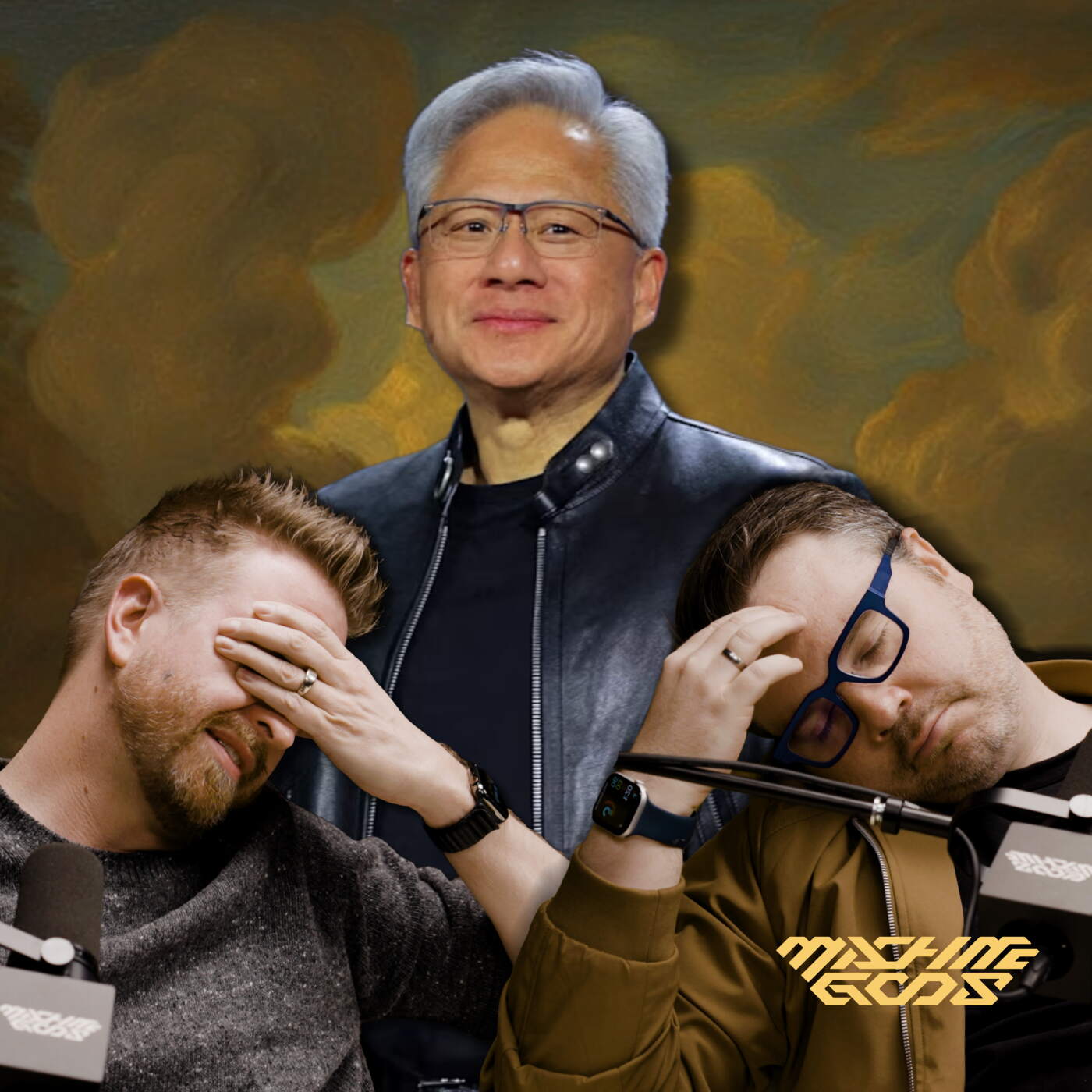
Casey Newton: This was a new one for me. The other night, my fiancé is out at the movies and the doorbell rings, and I have not had dinner. I've had a very busy day making the show with you, and I open the door and there's a man standing there with a pizza. And I said, "Is this for my address?" And I say my address, and he says, "Yes." I say, "Okay." So I take it upstairs and I think, you know, my fiancé's so thoughtful. The guy, like, sent me a pizza. Like, I love this guy.
Kevin Roose: Yeah.
Newton: You know what I mean? And so I open up the pizza box and it was one of these situations where the pizza was ice cold, so I think, "I gotta microwave this." So I, you know, tear off a couple pieces and I go and I micro— and I'm, like, three seconds into the microwave and the doorbell rings, and I think, "This was not my pizza."
Roose: [Laughs]
Newton: So I take the pizza out of the microwave—
Roose: Who—
Newton: And I put it back in the box because—
Roose: Wait, whose piz— who was at the doorbell?
Newton: So I grab the pizza, I walk downstairs, I open the door. Not only is the DoorDasher there, but there is what I would describe as an angry-looking man who I assume must have been my neighbor. And I said, "Is— was this your pizza?" And he goes, "Yeah."
Roose: [Laughs]
Newton: And I said, "I don't know what to tell you. He said it was my address."
Roose: [Laughs]
Newton: And so I handed over the pizza and, you know, that's what's going on, Kevin.
Roose: Did you tell him that you had microwaved several slices?
Newton: Absolutely not.
Roose: [Laughs]
Newton: Absolutely not. And it occurred to me that he was going to be able to tell when he opened the box.
Roose: "Why are two slices of this pizza mysteriously blazing hot and separated from the rest of them?"
Newton: Here's the thing: do not hand me a pizza if you don't want me to eat it, America.
Roose: [Laughs] I'm Kevin Roose.
Newton: I'm Casey Newton.
Roose: And from San Francisco, in partnership with NPR, this is Machine Gods.
Newton: The official podcast of the Singularity starts now. Machine Gods. Well, Kevin, it's Thanksgiving week in America, and that means it's time for one of our country's favorite traditions: pardoning a CEO.
Roose: [Laughs] I assume you're talking about Jensen Huang.
Newton: That's right. The Nvidia CEO who some people said would never be so back is, in fact, so back.
Roose: Yes, Jensen Huang is back after 11 days in the wilderness atoning for his sins. He's been reinstated by Nvidia's board. This happened early Monday morning, and—
Newton: Hours ago as we record this.
Roose: Yes, hours ago the board voted unanimously to bring Jensen Huang back as president, CEO, and board director, effective immediately. My God, I almost fell out of my chair.
Newton: I woke up to this news.
Roose: [Laughs]
Newton: It was one of these things where I, you know, grab my iPad, I'm looking at the, you know, the day's news, and like three minutes earlier Jensen Huang had been reinstated, and I screamed, Kevin.
Roose: [Laughs]
Newton: I screamed in my bedroom and I said, "You have got to be kidding me."
Roose: [Laughs] How did your partner react to you just screaming randomly in the bedroom?
Newton: Well, fortunately he was already up and at the gym.
Roose: [Laughs]
Newton: And I respect that about him.
Roose: [Laughs] Wait, so you screamed in your house alone?
Newton: To myself.
Roose: [Laughs] That's how big this news is.
Newton: It really is.
Roose: Well, I'm surprised that you were surprised because, as you will recall, you actually predicted this. Back when Jensen Huang was fired those long 11 days ago, you said that you thought this was not the end of his reign. What did you know, and what were your sources telling you?
Newton: I have to say, I have been on such a rollercoaster about this, because when he was first fired, I thought, "There is no way that this sticks." We live in a time of zero accountability. The oligarchs seem to operate with near total impunity in this country. But sitting here in this chair, Kevin Roose, you convinced me that it was gonna be different this time. And in fact, I went out and I wrote a whole newsletter, the title of which was ‘The lol nothing matters’ era of American tech and business is over. Well, I am devastated to report that ‘the lol nothing matters’ era is back.
Roose: So you're pinning this on me, in other words, the fact that you were so publicly right and then so publicly wrong?
Newton: Yes. Once again, you used your charms and wiles against me and led me astray, and I've had enough of it.
Roose: [Laughs] Speaking of using your charms and wiles to get what you want, let's talk about how this actually went down.
Newton: Yeah, how'd it go down?
Roose: So this was a very fast turn. As recently as last week we were hearing from folks close to the Nvidia board that they were not going to consider bringing Jensen Huang back, but it appears, Casey, that a certain president got involved.
Newton: Boy, did he.
Roose: The board of Nvidia said that it, quote, "received input from senior levels of the United States government" that made them confident that Jensen Huang was not a national security risk. Then on Monday we got reports that Trump may have dialed into the Nvidia board meeting on Sunday night where this was being debated. That came from Semafor. We also got reporting from Maggie Haberman and Jonathan Swan at The New York Times that this was in part a project of Trump and JD Vance, and that Vance, quote, "spoke privately with Jensen Huang over the weekend and helped the Nvidia board get the assurances it needed that the Trump administration did not believe that Mr. Huang himself posed a national security risk."
Newton: This is crazy and bad in so many ways, and we truly will not have time to get into all of them in this podcast segment, though have no fear, I'm sure we will return to the subject in coming episodes. But just to name a few, Kevin, the Nvidia board currently has an open investigation into Jensen Huang. I don't understand how anyone can have the, quote, "full assurances" that nothing wrong has happened when these investigations are still ongoing, unless they have simply been canceled. And that's just what's going on at Nvidia. The federal government is investigating Jensen Huang and Nvidia. Jensen Huang is gonna go up in front of Congress next month to answer questions about this. So this idea that, well, everyone looked into it and everything is going to be okay is just a lie. They're lying to you.
Roose: Yeah, there are no completed investigations yet. I would say the investigations have just begun, and there are plans to investigate more in the coming Congress, and I expect this will be a major topic for the Democrats, who will now control both houses of Congress.
Newton: Absolutely.
Roose: So let's talk a little bit about how people are reacting to this. Jensen Huang himself was quoted in a statement saying that he was "honored to return to Nvidia. And above all, I am grateful for the love and support of my family. I can't wait to get back to work."
Newton: And notably, his family has not released a statement saying that they love him.
Roose: [Laughs]
Newton: So I'm still waiting to hear back on that.
Roose: [Laughs] Donald Trump has been very active this morning on Truth Social, posting that he believes the Nvidia board of directors, quote, "has made the correct and proper decision to return Jensen Huang to the position of CEO. The country needs Jensen's leadership at Nvidia in order to ensure the success and prosperity of not only the company, but the American economy." He also posted a meme of Jensen Huang triumphantly holding up a bra. This was sort of a take on the assassination photos of Trump, you know, pumping his fist.
Newton: Think about what you just said. The President of the United States, who was almost assassinated, made a meme of Jensen Huang surviving the attempt to fire him, and making fun of the fact that Jensen Huang had three known affairs, one with a suspected Chinese spy, two with a subordinate.
Roose: Yeah.
Newton: All of this is really happening. The most predominant take on X this morning is we are truly living in a GTA VI world. Because GTA VI is full of these memes, and once again, reality is running way ahead of the satire.
Roose: Yes. But you know who's loving this is the stock market. The—
Newton: Oh, and finally we get to the only important thing in America. Why did we talk about anything else first?
Roose: [Laughs] The stock price of Nvidia, which has been battered in recent days, was up, way up on this news. Nvidia's market value increased by about a trillion dollars on Monday when the market first opened, and the Stand with Jensen crowd of various tech moguls and oligarchs is exceedingly pleased with itself. Elon Musk said on X, quote, "It is done and the mistake has been corrected." Marc Andreessen changed his X bio to, "We have to protect our geniuses," which was a quote from President Trump about Jensen Huang.
Newton: Yeah, look, I think in recent days, the venture capitalist class had become very concerned that suddenly there was going to be accountability for people's actions. They could not operate with impunity. And now, of course, they're all breathing a huge sigh of relief because if Jensen can't get fired for this, well, their jobs are probably gonna be safe for a long time too.
Roose: Yes, I think there were concerns among investors that there would be accountability for other actions, but I also think there were a lot of investors who were scared that Jensen Huang leaving Nvidia would sort of mark the beginning of the end of some kind of stock market rally that was gonna benefit them in various ways.
Newton: Yes, but again, this is such short-term thinking, because eventually Jensen Huang is not going to be able to run Nvidia anymore, Kevin. The man is already 63. He's done almost no succession planning, aside from appointing a couple of his children to be some of his top lieutenants. So this is where I think that everyone is being incredibly shortsighted. Like, don't get me wrong, this probably gets Trump through the end of his presidency, right? We know that the stock market appears to be the most important thing to him, certainly more important than national security, right? But in the end, somebody else is going to have to run Nvidia. This was the opportunity that the company had to start building a bench, and instead they're just going back to the guy who sleeps with his subordinates.
Roose: So why do you think this was? Was it just because of the stock market?
Newton: Yes. I think that time and again, what we have seen from this president is that he looks at the stock price, and that is how he makes his decision. We also know there's been a lot of insider trading around the stock price, right? And so I'm gonna be very interested [laughs] to see who made money over the past few days as word inevitably trickled out that Jensen was going to come back. But that is the bet that he is making. I think it's also notable that President Trump had a meeting with Xi Jinping over the past few days, and they appeared to have a sort of friendly meeting. I think Trump thinks that Xi Jinping is his friend, and so there's just effectively kind of nothing to worry about when it comes to Nvidia and AI, and he said, "Let Jensen do what he wants."
Roose: Yeah, I mean, I thought the explanation that Trump gave this morning— he was being interviewed about the decision to encourage Nvidia's board to bring Jensen Huang back, and he said something along the lines of, well, he could have sort of lent his talents to a Chinese AI company if he was so mad at the US for getting pushed out. And I just think that's a very interesting way to defend a CEO of a leading American tech company. Like, he might get so mad about being fired that he would sort of defect and help our main adversary? And for that reason, we should keep him installed at the head of one of our most important companies?
Newton: Yeah, like suggesting that Jensen had this, like, massive leverage over the United States. Now, in the end, he may have had big leverage over the current state of the stock market, but that, you know— But I very much agree with you. It is crazy to say that unless we appointed him, he would go start a rival chip company in China.
Roose: So the stock market is obviously one justification that we've heard for bringing Jensen Huang back, but there's still this lingering issue about whether he was aware of Alice Huang's connections to Chinese intelligence. There's been some reporting in recent days suggesting that her connection to Chinese intelligence was stronger and longer lasting than maybe we had originally thought. So what is the state of those investigations, and what does it mean now that Jensen Huang is coming back?
Newton: Well, I mean, the way I see it, there are two factions within the Trump administration. There is the faction that just wants to keep the stock prices of everything high and rising, and then there are the China hawks who are really, really concerned about what is happening. And what they have sort of made known to the very good reporters who are breaking these stories is that against a backdrop of the venture class saying, "Jensen did nothing wrong, Alice probably wasn't even a spy," in fact, Kevin, it appears that intelligence agencies have documented that Alice Wang had very close contacts with an officer of China's Ministry of State Security from at least spring 2025 into this fall. So this was an ongoing situation when Jensen was fired.
Roose: And how much of that do you think the board feels like they understand, or do you just think they're gambling because we might learn more about Jensen and Alice or their connections to Chinese intelligence in the coming days and weeks?
Newton: I think it is a mistake to focus on Nvidia's board anymore because it has become clear that Nvidia's board has no role in governing this company. President Trump made a phone call. He said, "I want Jensen back," and now Jensen is back. It does not matter what Nvidia's board thought. It's inc— I would be incredibly embarrassed if I were on Nvidia's board, and I would resign if I were on Nvidia's board.
Roose: Yeah, I'll be very curious to see what the board does as more investigations come out. I mean, we have lots of investigations going on right now. Three House committees have scheduled closed-door testimony with Jensen Huang. The DOJ and the SEC are still investigating. Also, the California attorney general has subpoenaed Nvidia. So there's just going to be a lot more coming out on this, and I'll be very curious to see what, if anything, would cause them to change their mind again and say, "Actually, maybe we shouldn't have reinstated him."
Newton: Well, and this gets into a question that I am interested in, which is, realistically, what does the return of Jensen Huang look like? Because I think on Monday morning as we record this, there is a sense of triumphalism among, you know, people in the venture class, you know, those names that you just mentioned. I had a VC texting me essentially like, "Ha ha, you were so wrong about this," this morning. But pretty soon, Kevin, I think there is gonna be a hangover, and the hangover is going to be that Jensen Huang is going to be testifying and meeting with his lawyers more than he ever has in his entire life. The questions surrounding chip smuggling are not going away. I don't think the questions about his relationship with Alice Huang are going away. So if Jensen Huang thinks that he's gonna come back into this company and just get back to making cool chips and strutting around on stage in a leather jacket, I think he's got another thing coming.
Roose: Do you think he has to change his policy toward China now that he is sort of under this cloud of suspicion about his connections to Megaspeed and Alice Huang?
Newton: I think it would be incredibly shrewd of Jensen Huang to try to demonstrate that he had been humbled by this experience in any way. I would sort of be surprised if it happened. Go look at what dictators do after failed coups. It's not usually lead with a new spirit of unity. It's usually firing everybody who tried to got rid of them, or worse, and going even harder in the direction that they already wanted to. What do you think he's gonna do?
Roose: I think he's going to yell so much in meetings.
Newton: [Laughs]
Roose: I mean, I'm just remembering the reporting that came out last week from the Times and elsewhere about just his sort of management style at Nvidia and how he would sort of dress down subordinates.
Newton: I wouldn't use the word "dress down" in this context, but go ahead.
Roose: [Laughs] Yes. It's different than undressing. But he was known for sort of this abrasive, insult comic style of leadership.
Newton: Oh, it's worse than that. He bullied people. He threatened to kill them.
Roose: [Laughs] He did.
Newton: He did.
Roose: He did threaten to rip someone's— allegedly threatened to rip someone's arms off and beat them with— [laughs]
Newton: Yeah. Yeah.
Roose: [Laughs]
Newton: Why are we laughing? This is a—
Roose: It's not funny.
Newton: This is a horrible way to run a company.
Roose: No, this is peak American technology leadership according to the president of the United States. But look, I think there's going to be a lot of testimony, a lot of subpoenas, a lot of investigations. I think that's good. I think we still do not know nearly enough about this company's connections to China and Chinese chip smuggling, but I think it's fair to say that we have an administration that has concluded that it is more important that the stock market not fall than that we can trust one of the leading tech companies in the world not to be colluding with or conspiring with our primary geopolitical adversary.
Newton: Yeah. I feel like I have two more takes that I wanna share, Kevin.
Roose: What are they?
Newton: And then I will have said my piece on this.
Roose: What are they?
Newton: Number one is I'd like to say something about capitalism, if that would be okay.
Roose: Please.
Newton: So my understanding of our economy here in America is that a reason it has worked so well is that the government has largely stayed out of it and has just let creative, innovative people do their thing. And also, our government has upheld the rule of law, and so when people break the law or they do terrible things, they lose their jobs, right? And the Trump administration has sort of changed these rules without really telling us. Remember that as Jensen's mania for selling chips to anyone and everybody, including in China, increased, what Trump said was, "Okay, but you have to give the government a kickback." And so all of a sudden, the U.S. was in bed with Nvidia, right? And when he did that, President Trump increased the risk to all of us that if Jensen Huang ever did something really, really stupid, the government's finances were going to be implicated in that. And so weirdly, as all the venture class is, like, pumping their fists, it's like, "Yay, America," it's like it was actually the government's betrayal of capitalism and adoption of this kind of soft socialism that truly got us into this mess. So I'm sitting over here, the crazy liberal, being like [laughs] "You freaking socialists are putting the economy at risk."
Roose: It is giving central planning, like installing the CEO of one of the nation's leading technology companies over the objections of basically everyone else.
Newton: Absolutely. All right. Now let me say my final take on all of this, Kevin.
Roose: Please.
Newton: Which is something that I believe will be clear in time, is that great leadership means that more than one person can run a company, right? The reason Jensen Huang came back is because everybody freaked out that no one else can run Nvidia, and the person who worked hardest to ensure that that was true was Jensen Huang. This man is 63 years old, had done no succession planning. And I just wanna say, in Silicon Valley, we have a history of leaders who made different decisions. Look at Microsoft. Bill Gates set up Steve Ballmer to run Microsoft, and Ballmer set up Satya Nadella to run Microsoft, and Microsoft is thriving. Look at the way that Steve Jobs set up Tim Cook, and look at the way that Tim Cook set up John Ternus. These are just stable, normal companies where CEOs mostly are not threatening to kill the people who work for them, they're not having affairs with their in— subordinates, and they're certainly not having affairs with Chinese spies. This is the way you do it, and it can be done. And so Jensen Huang might be back, Kevin, and we'll see how long he lasts, but it is truly an embarrassment and should not be taken as a model because we have much better models for how you run a company.
Roose: Yes, preach. I'm glad to hear you, Casey Newton, defender of capitalism and free markets.
Newton: Thank you.
Roose: [Laughs] Buy a copy of Casey's Ayn Rand fan fiction coming out this December.
Newton: The Fountainhead II. This time it's personal, Kevin.
Roose: [Laughs] But I also— I'm thinking a lot about the last time we saw a major AI company dispense with its CEO and then rehire them days later. I'm talking of course about the 2023 blip, the five days in that case where Sam Altman was fired as CEO by the board and then brought back. Do you think there are any parallels or discrepancies between this situation with Jensen Huang and the situation with Sam Altman?
Newton: I mean, the board had much clearer reasons to get rid of Jensen Huang, you know, than they did to get rid of Sam Altman. You know, I've been thinking about this too. I don't know how well the comparisons hold for a bunch of reasons. In the OpenAI case, there was also an investigation into Sam Altman after he was fired, and it basically turned up nothing. They basically— they never released the report publicly. It all just kind of got swept under the rug. I think the more important thing, though, that happened to OpenAI after Sam came back is that while he did consolidate power, he also lost a lot of people, right? A lot of his top lieutenants and deputies left, and I don't think all of it was necessarily related to his firing or the reasons that he was fired. But I do think that it was a big stumbling block for OpenAI, and I would not be surprised if in the coming weeks and months we see a lot of Nvidia execs walk out the door, starting with their interim CEO, Colette Kress, who according to some reporting I read just before we started recording, basically was not informed that any of this was happening until the last minute. So you're gonna see Nvidia lose a lot of people, and we're gonna find out how many other people at that company were doing work besides Jensen Huang.
Roose: Yeah. I'll just say, like, having written a lot about the blip at OpenAI, my sense is that in the wake of that, it just became a different company. It was clear that the sort of one accountability measure that was available to the board was not going to work because the company had become too important. It was kind of this load-bearing cog in the American economy, and so the forces of capitalism and the forces of sort of defending, you know, investor money and sort of status quo prevailed on what was trying to be a board doing the right thing. I think you're right that in this case, Nvidia's board had many more reasons to go after Jensen Huang than OpenAI's board at least publicly stated to fire Sam Altman. But I do think there's a similar dynamic emerging where you have a company, they sort of seem like they're going to do the right thing, the obvious corporate governance thing that you should do in a position, and then it just kinda doesn't happen. I will be very interested to see what role Jensen Huang had in his own comeback and orchestrating his comeback. I imagine he's been a very active person in all of this, because we know that, you know, he was ready to come back. He wanted to come back. He was not taking his fate lying down.
Newton: No, he was preten— and, but he's still out there pretending like, you know, bringing him back was other people's idea when obviously this is all he want— He doesn't know how to do anything else besides run Nvidia. What's he gonna do, spend time with his family?
Roose: [Laughs]
Newton: Well, that's enough about that turkey.
Roose: [Laughs]
Newton: When we come back, math.
Roose: All right, Casey, it is time to talk about math, where we have had some shocking developments in the last few days.
Newton: Finally.
Roose: Well, we've talked previously about how AI is sort of crunching through some of the hardest problems in mathematics, including the Navier-Stokes equation, which we discussed in a previous episode. But we got a major new development last week when a mathematician at Anthropic claimed that he and Claude had proved the Riemann hypothesis.
Newton: Okay, now, Kevin, you can tell me about this, but I'm gonna warn you, if you do, I am gonna forget everything I learned about the Navier-Stokes hypothesis.
Roose: [Laughs] Yeah, I'm not expecting you to hold more than one hard math problem in your head at a time.
Newton: Thank goodness.
Roose: So just for our non-mathematical listeners, the Riemann hypothesis is considered kind of the holy grail of mathematics. It is a problem that mathematicians have been laboring to solve for literally more than a century. It comes from a German mathematician, Bernhard Riemann, who predicted in 1859 that there was a hidden pattern underlying prime numbers. He found a way to turn prime numbers into a map filled with special zero points, and Riemann claimed, this was his hypothesis, that every single one of those points lined up on a straight line all the way to infinity. And mathematicians have been struggling to prove or disprove the Riemann hypothesis ever since, until last week, when Levent Alpöge, a mathematician working at Anthropic, posted a four-page note, PDF on his personal website titled "remark."
Newton: Not a great headline.
Roose: [Laughs] Not a great headline. But what was in the remark was extraordinary.
Newton: Remarkable, even.
Roose: Remarkable, yes. Alpöge claimed that he had proven that the Riemann hypothesis is true. The proof itself is 17 million lines of code. Did you read the four-page PDF?
Newton: No. I read the summary of it, Kevin, and I felt like that really got me where I needed to go.
Roose: Well, it was a striking document, in part because I think Levent Alpöge is very good at sort of explaining the emotional reaction that he had to proving this hypothesis with Claude. I'll just read a passage from it.
Newton: Yeah.
Roose: He writes, "Claude and I have had a great time together with such breadth in recent months, but this time Claude far outpaced me near the finish line. No, Claude flew and danced and sparkled near that finish line." So I think we didn't know right away whether this proof checked out or not, but over the weekend, mathematicians have been working to verify it. They've run it through these sort of Lean checkers, these formal verifiers where you can basically have a computer check your proof and determine whether it is correct. It appears to be correct. So with what we know right now, we can say that the Riemann hypothesis has been proven.
Newton: That— okay, so we've used a different computer system that we don't understand to assure us that the other computer that we don't understand is correct.
Roose: Well, I don't know enough about Lean to know whether it is actually definitive proof, but the people who are sort of are in charge of this, the sort of neutral third-party judges, have said everything looks like it checks out here.
Newton: Yeah, it's getting good reviews.
Roose: So Sundar Pichai, CEO of Google, very excited about this. He said, "Somewhere Euler, Gauss, and Riemann are in awe today." Alexandr Wang, the Meta AI head, wrote a post called "Superintelligence is Arriving," where he says that, quote, "Nothing humanity has ever accomplished compares to proving the Riemann hypothesis in terms of sheer intellectual might and strength." And the tech industry seems to view this as a data point that we are, in fact, on the brink of the singularity, if even the hardest math problems ever devised are now falling to these AI systems.
Newton: Well, how much do you think that that is true?
Roose: I think this, to me, is just a big data point in favor of short timelines, in favor of the possibility that these systems are going to do what they have done in math in other domains. I mean, remember, and I've said this before on this show, so forgive my repetition, but several years ago, AI could not do basic arithmetic. It would tell you that two plus two was seven. It would mistake the number of R's in "strawberry." In a span of about three years, we have gone from that level of capability to now solving what most mathematicians considered the hardest problem in mathematics. And, you know, I saw some takes out there about the Riemann proof that basically said, "Look, why is it surprising that computers are good at math?" But I think that really misses the difficulty of this problem. This was not just a computer being good at math. This was a computer thinking creatively about how to combine insights and steps from various branches of mathematics, including some that humans had been laboring over for decades, and finding these novel insights from all of these different parts of mathematics.
Newton: Yeah, this is not your TI-83 graphing a parabola.
Roose: Right.
Newton: Like, this is actually a contribution to new knowledge in the world, which until very recently a lot of skeptics said that they believed a large language model would never be able to achieve.
Roose: I think in my mind, the trillion-dollar, maybe existential, question is, like, how special is math as a domain? How many domains have the right combination of these sort of hard, open problems that humans have tried and failed to solve for decades, that AI models will be able to make very fast progress on? I think a lot of the fear you're seeing from people who are researchers in science, in biology, in, like, various disciplines is, like, maybe it's not just math. Maybe this kind of model capability, the kind that allows one mathematician with an unreleased version of Claude solve the hardest problem in mathematics, maybe that is going to be possible for every other discipline, too.
Newton: I mean, I'm just gonna guess that it's not that special. Like, I think we've just already seen this year huge advances in domains outside of math that suggest that there isn't that much special about it. I'm thinking specifically of robotics, where there have been staggering leaps in the ability to train robots. And, you know, at the end of the day, that's software, which I guess means, like, there is math involved, but it's not, like, a purely academic discipline. Also creativity. Go on X. Look at the video games that people are apparently one-shotting using Claude Fable. For, not a long time, but let's say many months, people were saying, "Well, look, AI might be able to do all this fancy nerd stuff, but it's never gonna touch, you know, the creativity of the human spirit." Well, you know, again, just, like, go look at some of these clips. So I think it is important insofar as AI has gotten very far in math, and that is one of the first places where we're seeing this, but it is not gonna be the last one.
Roose: I mean, what's been interesting to me is not just watching the sort of digestion and interpretation of the results, but also the emotional reactions that mathematicians are having, which really span the gamut from very stringent denial and anger at Anthropic and OpenAI for doing these math proofs using AI, all the way to a sort of acceptance of, like, well, maybe our whole discipline is obsolete, and we should all change careers or at least approach our work very differently. So I wanted to read you a statement that the Association for Human Mathematics put out. They are kind of the anti-AI wing of the mathematical discipline. They wrote, quote, "This announcement is a major departure from traditional methods in mathematical research, representing a new value system put forward by AI corporations that foregrounds technical validity of logical statements over accountability, clarity, accessibility, and understanding." Did you see that, and what did you make of it?
Newton: I would say that it's news to me that there are human mathematicians who have placed a premium on accessibility and explainability. You know, I mean, look, I have a lot of empathy for these folks. I think that most of us are gonna find ourselves in the same situation that they are, and I guess some credit to them for fighting the good fight. But I will say that on questions of pure mathematics, at the end of the day, the most important thing to me is, like, well, did we advance human understanding or not?
Roose: Yeah, I share that. I think it's like if you are a mathematician who spent your whole career trying to solve these problems, it has gotta be very hard and upsetting to watch an AI company that may or may not actually care about your field, that has not gone through all the training, that is just sort of wielding these, you know, these experimental models and using them to show off their systems and their capabilities. Like, I can see how that would be extremely frustrating as a human mathematician. At the same time, there are actual mathematical implications for whether the Riemann hypothesis is proven or not. There are a lot of other proofs that kind of rely on or assume that the Riemann hypothesis is true, and it could have other sort of implications in various fields of mathematics. And I think the mathematicians, the ones of them that aren't just resisting AI altogether, are gonna have a lot of work cut out for them in the next few years of just unpacking all of the insights and the discoveries that Claude appears to have made in the course of proving the Riemann hypothesis.
Newton: Yeah, and that gets to what I think is maybe the most interesting thing about this story to me, which is that, you know, the first thing that happens when the super-powered AI solves the Riemann hypothesis with a little bit of human help isn't that we all look at it and say, like, "Oh, that's how it works." We say, "Oh, the smartest people in the world are going to need to spend the next several weeks trying to understand the AI's logic." And I wonder if that isn't going to just be the new norm across a lot of disciplines, where, yes, the AI system is going to solve a problem, it's going to make a discovery, but it is then going to be up to humans to try to reverse engineer it to understand what it means, how it works.
Roose: Yeah, I think that's a good model going forward, and you're already starting to see mathematicians saying, like—
Newton: I'm not sure it's a good model. It, like, kind of freaks me out a little bit.
Roose: No, I'm not saying it's good for the mathematicians or good for society if there is sort of this level of advanced intelligence and thought that we only can try our best to interpret that is, like, running the world. Like, I think that is the risk here, is that we just sort of develop systems that are so much more capable than us that all we can do is really just try to understand the decisions they are making, the proofs they are writing, et cetera.
Newton: Yeah. There's a great Ted Chiang story about this in one of his books. In the year 2000, he wrote it actually for Nature, for the journal, and he sort of contemplates a world where human beings have not submitted any new research to Nature or any other journal for, like, 25 years because in this world there's a sort of evolved human which he calls metahumans, and I think in this world basically they've been enhanced with AI in the modern understanding. And he sort of imagines that there's this world where what the human researchers do is not to actually try to advance human understanding, it is just try to understand and explain the thing that the superhumans figured out. And man, reading that knowing that he was sort of thinking about these things 26 years ago and what a futuristic scenario that seemed like, and now here in 2026 we are the humans trying to understand how Claude solved the Riemann hypothesis, if that doesn't give you some pause and make you feel slightly disoriented, I don't know what to tell you.
Roose: I think for me, my surprise here is that I incorrectly assumed that we would have kind of the automation of mundane white-collar labor before we had the novel discoveries. Like, I think if you had asked me a couple years ago, like, what will happen first, that, like, accounting firms use AI to replace half their workers or that AI proves the Riemann hypothesis, I think I would've predicted that one of them, the accounting firm replacement, was much easier than the Riemann hypothesis. And so I've just been surprised that we have gotten these incredible discoveries, and yet the job market is still kind of chugging along and we haven't seen widespread labor replacement from AI.
Newton: Yeah, I mean, you know, we've been operating under an assumption that it was gonna be incredibly difficult for these systems to contribute to net new knowledge. And so I think this is gonna be a massive update for people about that. On the other hand, the Riemann hypothesis, the nice thing about it is you only have to solve it once. If you're an accountant, you have to do it every day, and there are gonna be a lot of edge cases in that that actually do require some human intervention.
Roose: Yeah, maybe that's a reason for optimism, where, like, we could have these models that are plowing through some of our hardest open problems, and maybe there will still be plenty of jobs for people to try to understand and interpret and apply the knowledge that AI is discovering to the tasks that we actually care about.
Newton: Yeah.
Roose: Casey, what do you think is next? What is the next big milestone that you're looking at for AI capabilities?
Newton: I think we'll know that AGI is here when it can run Nvidia, and I think we're close.
Roose: [Laughs]
Newton: I think given what I've seen in terms of how humans run that company, there's a lot of what I would call low-hanging fruit in terms of how it could be done better. And so look for that in 2027.
Roose: I think AI already does run Nvidia.
Newton: Yeah.
Roose: It stands for Administration Interference. Is that good? [laughs]
Newton: That's pretty good.
Roose: All right, Casey.
Newton: Yeah.
Roose: For our final segment today, we wanted to do something a little topical, a little seasonal. We wanted to help our listeners with their Thanksgivings.
Newton: Yes. You know, many podcasts will do advice around the holidays, and we got a question that it felt like we might actually be in a good position to answer.
Roose: So listener Blythe wrote in to ask us, "What are the three concise AI talking points you would have ready to share with your family," at Thanksgiving presumably, "as we head into 2027?"
Newton: After your uncle finishes his racist tirade and the local data center comes up, our listener wants to know, what do you say?
Roose: Exactly.
Newton: What do you say about AI?
Roose: So Casey, let's first of all start by examining the premise here.
Newton: Yeah.
Roose: Is AI something you should be discussing with your family at Thanksgiving?
Newton: [Laughs] Listen, when it comes to discussing AI, I try to operate in a consent-based culture.
Roose: [Laughs]
Newton: So I am not out there just volunteering my opinions about AI to people. Now, it so happens that it will often come up in conversation, and of course I'm always happy to engage, but I would not do one of those, you know, where you sort of tap your little fork against your cups and say, "Now, now, what has everyone been thinking about the METR Time Horizon Report?"
Roose: Yeah, that's not gonna go over well unless you have a very specific kind of family.
Newton: Yes.
Roose: But Casey, what should our listeners be telling their families or talking about with their families if this does come up at Thanksgiving?
Newton: So I have given this some thought, and I came up with two things that I might offer, again, extremely conditionally in a world where AI has sort of already come up. And the first thing I would suggest you might want to tell your family, Kevin, is to try it, and what I mean by that is, have you actually sat down in front of ChatGPT recently and asked it to do something? Have you tried to see if an agent could buy something cheap for you just to see what that experience was like? And I say all of this not as an unrelenting promoter of the AI industry, but because it remains the best way I know how to wrap your brain around what is happening.
Roose: Yes, that was my first piece of advice, too, is like, show, don't tell.
Newton: Yeah.
Roose: Something that you've been saying recently that has really stuck with me is that you really have to see a computer using itself.
Newton: [Laughs] Yes.
Roose: There is something about the computer use that these agents can now do where they can take over your browser and fill out a form or build you a website where it really does feel like a light bulb goes off in a lot of people's heads, not everyone's.
Newton: Yeah. And look, I don't think this is going to, you know, necessarily make people feel differently about AI. You might really hate AI. You're very fearful of the world that it is bringing into being. I still think in that world, you want to watch a computer use itself because it is just going to frankly give you more ammunition as you're sort of out there in the world talking about your own beliefs on the subject.
Roose: So what is a prompt or a demo that our listeners could run for their families? I would say maybe wait till after dinner.
Newton: Yeah.
Roose: Maybe wait till everyone's sitting around, like, watching football and falling asleep.
Newton: Yeah.
Roose: But like, what is a thing that you could show them if you are interested in hypothetically trying to display some of this to your family?
Newton: My favorite thing for people to do is to build a website, right? Because the AI can build lots of great websites. It can build it very quickly. They can be incredibly creative. Maybe you could say, "Hey, I'm gonna upload, you know, four or five photos from Thanksgiving that I've taken, and I want you to make a comprehensive website about the Roose family's Thanksgiving." And then just watch it go to work. If you were, if you have not seen a computer do this before, I do think you will leave feeling somewhat shaken, somewhat impressed, but your mind will be expanded about what might be possible.
Roose: Okay, what is the other thing that our listeners should take away?
Newton: So, and you can tell me if this is a cop-out, but I felt, I feel like if AI comes up at Thanksgiving, and you are a well-informed person, and let's face it, Kevin, if they're listening to Machine Gods, they're an incredibly well-informed person. They're probably top 1% well-informed person. I think your role, should you so choose, is to try to expand the Overton window of conversation about AI in your family, right?
Roose: Explain what that means.
Newton: So every family's gonna be coming to this conversation with a different level of knowledge about AI, with different sorts of feelings about AI, and I think wherever you might find them, the job that you could take on for yourself is just to sort of ask them about what lies just a little bit beyond their frame of reference. So if you're at a family where truly no one has ever used ChatGPT, the entire conversation really could just be, "Here, I'm gonna hand you my phone. Ask it a question. Have it write you a poem, have it build you a website," and just kind of get their imaginations going. If, on the other hand, your family is, you know, protesting the local data centers, very well-informed, you may want to talk to them about recursive self-improvement. You might want to say, "Hey, listen, I understand we're really, you know, concerned about what's happening in our community, and I'm worried that what is happening inside this data center might put our family at risk, and so let's talk about that." So if you're like Kevin and me and you believe this is the biggest story in the world, figure out where your family is and then try to fill in some of the other parts of the story because unlike many conversations that come up at Thanksgiving dinner, Kevin, this one just is not actually boring.
Roose: Yeah, and it's not also polarized in a predictable way.
Newton: Yeah.
Roose: Like, your Republican uncle might be really worried about recursive self-improvement, and your progressive aunt might have concerns about the environmental impact of data centers, and maybe is there is some way to kind of find some common ground there and be a peacemaker rather than an agent of division at your Thanksgiving dinner.
Newton: Oh, just imagine, unity at the Thanksgiving table around being mad at the world. Yeah, actually, that checks out.
Roose: Yeah, and then your cousin's gonna ask if he can be excused from Thanksgiving dinner to go talk to his AI girlfriend, and all hell will break loose.
Newton: You know, when I was growing up, cousins used to leave the Thanksgiving table to go take a walk in the neighborhood and smoke weed.
Roose: [Laughs]
Newton: But I guess that's been canceled now that the Democrats have won re-election. So Kevin, what are your tips for families that are sitting down at the Thanksgiving table and AI comes up?
Roose: Well, the points that I often use to just sort of communicate the sort of state of the situation with AI are, there are three of them. First, AI is improving rapidly and predictably across many domains. Two, the people who are most worried about this are the people closest to the technology, the people at the AI companies. And three, we don't know how it works. I find that those three facts sort of taken together offer a good set of questions and maybe answers to some of those questions.
Newton: And what do you think people should do with those pieces of information?
Roose: I mean, I think the first thing you can do is just try to sort of listen. How does that make the people in your family feel? Are they worried? Are they skeptical? Do they think this is all a big, you know, bubble of hype? So I think that can often be more useful than trying to argue with someone or persuade them to believe what you believe.
Newton: I think that's really smart, and I actually have maybe one final tip about AI and Thanksgiving that I would like to offer to all of humanity, Kevin, in the spirit of goodwill.
Roose: What's that?
Newton: Here's what I would say. If anything goes wrong at your Thanksgiving dinner, you look around the table and you say to your family members, "I used an AI recipe, and I'm sorry."
Roose: [Laughs] I like that. We can s—
Newton: Throw the AI under the bus. It can take it.
Roose: It can take it.
Newton: It can take it.
Roose: There you have it, folks. Happy Thanksgiving.
Newton: Happy Thanksgiving.
Roose: I'm thankful for you this year.
Newton: I'm thankful for you as well, Kevin. Kevin, who makes this show?
Roose: Machine Gods is made in partnership with NPR, with generous support from the Tarbell Center for AI Journalism, the William and Flora Hewlett Foundation, and Emerson Collective. This episode was produced by Sasha Ashall and Jacob Blumberg. Our senior producer is Rachel Cohn. Our executive producer is Danush Parvaneh. Original music by Armen Bazarian. Branding and visual design by Alex Castro. Special thanks to Oren Rosenbaum, Erica Berry, and Nadine Zylstra.
Newton: Keep sending us all your great questions about AI and technology. Send email, voice memos, and short videos to hey@machinegods.fm or leave us a comment wherever you're getting the podcast.
Roose: And for the love of the gods, please don't forget to like and subscribe.
Newton: And until next time, stay blessed.