
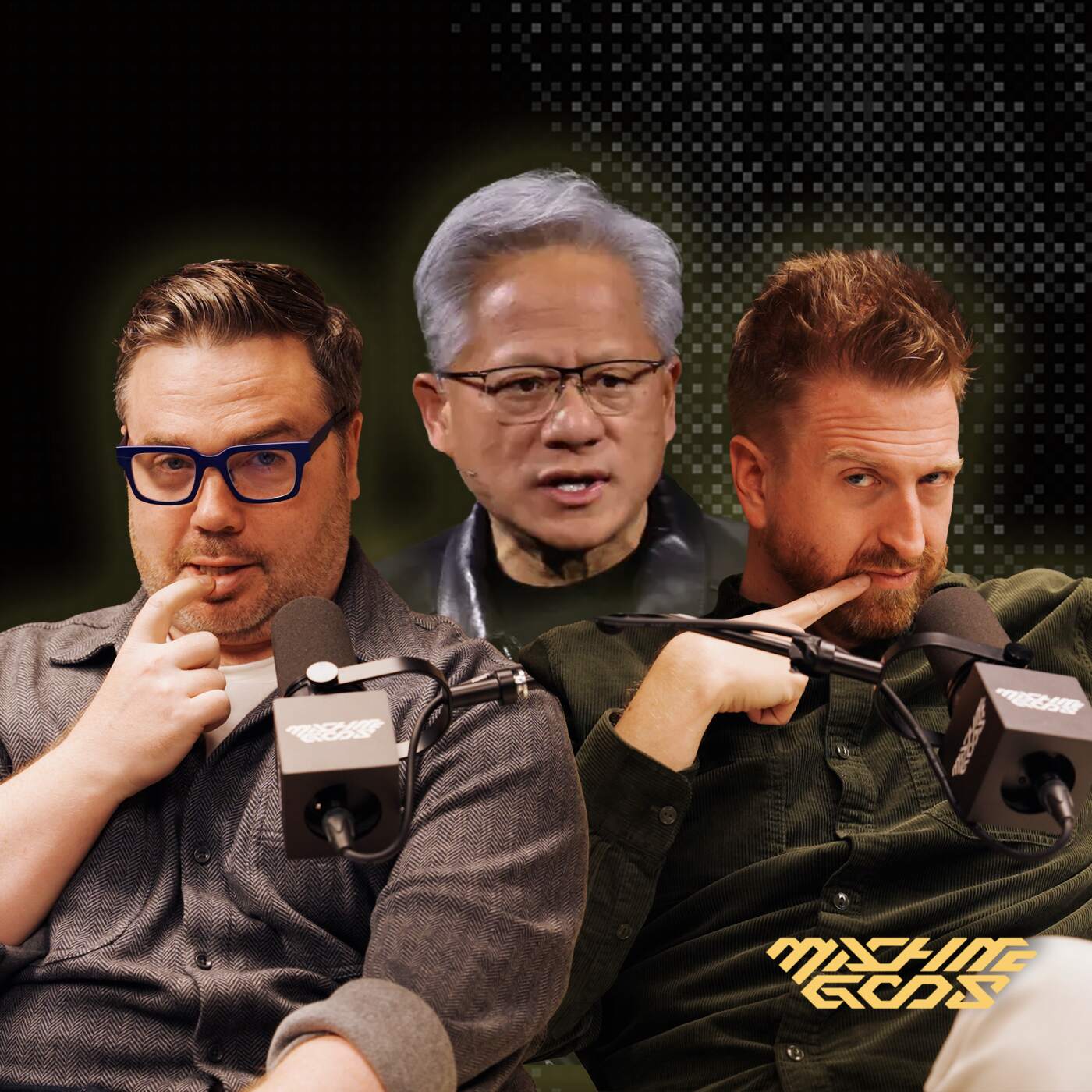
Kevin Roose: Can Nvidia's CEO survive a sex scandal with a Chinese spy?
Casey Newton: What else is the company hiding?
Roose: Can Democrats turn the AI backlash into an actual plan?
Newton: And where did Rep. Greg Casar lose his AirPods?
Roose: I'm Kevin Roose.
Newton: I'm Casey Newton.
Roose: And from San Francisco, this is Machine Gods, in partnership with NPR.
Newton: The official podcast for the singularity starts now.
Roose: Casey, we have to start today by talking about this Jensen Huang spy story. It is, I think, the craziest story of the year so far, and it's almost the end of the year.
Newton: Yeah. I think that it's certainly going to be very near the top of that list when we make it in just a few weeks.
Roose: Okay, so let's just briefly recap where we've been, what's been happening over the weekend, and what we know about this story, because as of this recording on Monday morning, a lot is still unknown, but it's moving very quickly.
Newton: Yeah. True.
Roose: Last week, we talked with Ana Swanson from The New York Times, who walked us through this reporting that she had been doing with her colleagues about how Jensen Huang, the CEO of Nvidia, had gotten close to a woman that US intelligence had determined was a Chinese intelligence asset. That woman, Alice Huang, was an executive at Megaspeed, a company based in Singapore that had been suspected of helping to illegally smuggle Nvidia's chips into China. But at the time, all we knew was that this relationship was, quote, "close." And I sort of asked Ana, like, "Hey, was there anything more going on between Jensen and Alice?" And her response was basically, "We can't say anything more than what's in our story."
Newton: And you and I talked afterwards, and we were sort of like, we feel like if you read between the lines here, there's more going on. But we couldn't get it on the record, Kevin, until this moment.
Roose: Yes. So then on Sunday, Jensen came out with it himself. He wrote a memo to staff in which he admitted to having an affair. This memo, which Nvidia posted publicly, I'll just read the relevant passage here. It says, quote, "I owe my family and all of you an apology. I was unfaithful to my wife. My actions hurt her and our children. There is no excuse for what I did. I am deeply sorry." Nvidia's board is now investigating this relationship. According to The Times, Jensen Huang told the board that he had been intimate with Alice Huang, this suspected Chinese spy. The company claims that the board has no reason to believe that national security or Nvidia secrets were compromised. An Nvidia spokesperson told CNN, quote, "Today's news will not slow Nvidia."
Newton: Yeah, because why would it? Why, when you find out that your CEO has been in an intimate relationship with a Chinese spy would that slow you down for even a moment? Nothing must stand in the way of chip production, Kevin.
Roose: I cannot believe how crazy this story is, 'cause, Casey, it keeps getting crazier. On Sunday, President Trump, who has been very close to Jensen Huang for a long time—
Newton: Although not in the way that Jensen was close to Alice Huang.
Roose: [Laughs] No.
Newton: Yeah.
Roose: We don't think it was that kind of a relationship. He was asked about this news that Huang had admitted to having an affair. He said he still thinks he's an honorable guy who, quote, "probably has an excuse for it." And he said that he would certainly take him on next week's trip to Asia. So this has really shaken the entire AI world, and I'm desperate to know what you make of this and what your reaction was.
Newton: Oh, man. I mean, there are so many different things to discuss in here, but I think we probably just have to start with how central Nvidia is to the AI industry, to the build-out. I think that by some measures, this probably is the most important company in the world right now. AI does not happen without Nvidia chips, and Jensen Huang is uniquely central to Nvidia. There are other companies where there is sort of big roster of executives, where there is a succession plan, where you sort of know what might happen if a CEO sort of mysteriously disappeared. That is not the case at Nvidia, and so that just leaves a lot of questions about how, basically, no matter how bad this scandal gets, it is unclear what anyone can do about it.
Roose: Yeah. It's wild, because not only is Nvidia so important, and not only is Jensen Huang so important to Nvidia, but he's also been at the center of the entire US policy conversation, and driving a lot of the policies that the Trump administration has put forward about China and export controls. And Casey, like, I've been thinking about this. I think this might be the most significant intelligence operation since the Cold War. Jensen Huang is not just some CEO. As you just said, he runs, like, one of the most important companies in the world. And Nvidia has been unusually vocal about not wanting to restrict the sale of its chips to China. They're basically alone in that position among major American companies. And now we know that while he was pushing for those policies and for loosening these export controls, he was also having an affair with a Chinese spy. And not just any Chinese spy, but a top executive at Megaspeed, which has been accused and investigated by US officials for helping to smuggle these chips into China.
Newton: And we should say that Jensen Huang was advocating for very minimal export controls long before he is believed to have gotten into this relationship. There are obvious self-serving reasons why he wants Nvidia to be able to sell as many chips as it wants everywhere. But certainly, Kevin, I think this is going to undermine Nvidia's position going forward. And this is a company that really, really aggressively pushed this line, in ways that we can talk about.
Roose: Well, totally. And it destroys his credibility, but it also, like, think about what the Chinese government could have done with this knowledge, right? It would not have been hard for them to sort of, once they knew that this affair was going on, to use it as leverage or blackmail material against Jensen Huang. To say, "Hey, it'd be a real shame if those export controls got tightened and some information about your affair get out." Now, like, we don't know that any of that happened, but just the potential for compromise here by this very high-ranking, very powerful business leader with ties, close ties to the Trump administration, like, it's just mind-boggling.
Newton: And that's why I get so frustrated when I see Nvidia already putting out statements saying that, you know, "We don't think there was any national security breach involved here." It's like, okay, well, you've also just told us that you're launching an independent investigation. It sure sounds like you've already come to the conclusion of that investigation before you even started.
Roose: No, I think there's a lot here, and I hope that this is a real investigation by the Nvidia board. I'm sure that Congress and law enforcement agencies in the US will also be investigating, because it's not just about the potential for blackmail. Jensen Huang is a person who has a lot of important national secrets in his possession. You know, the plans of the US frontier labs, the chip allotments, how Nvidia plans to design and build its next generation of chips. All of that is very sensitive information that would be very valuable in the hands of an adversary.
Newton: Sure, but I'm just gonna say right now, I put no stock in this alleged independent investigation that Nvidia says it is about to conduct. This company just got caught lying about the relationship that Jensen Huang was in with Alice Huang right? And the fact that Nvidia appears to have lied about it, I think, really undermines their credibility with everything that happens next.
Roose: Right. Well, we should also talk about one more thing that we've recently learned, which is that Nvidia may have directly intervened in a US Commerce Department investigation into Megaspeed, the company associated with Alice Huang. So this is according to The Times. Last year, the Commerce Department was reportedly in the midst of a months-long investigation into this alleged smuggling that Megaspeed may have been doing of chips into China, when Nvidia's general counsel intervened via email asking for information about the investigation. The investigation was abruptly transferred to the Justice Department out of concern that it might be compromised. And it is just increasingly clear that this is a very messy situation, and that no one has all of the details yet. There is a lot more to come on this story.
Newton: Yeah, but I think we do know the basic shape of it, Kevin, right? Which is that for over a year now, officials in the US government have been very concerned about this Megaspeed company, right? This company has a very unusual history. It was started by Alice Huang, a former television journalist who later got into private equity before founding a neocloud, a somewhat unusual career path, I think we could say, although an admirable one.
Roose: [Laughs]
Newton: After she starts this company, Nvidia names it essentially a favored trading partner, assuring that it will get access to great, top-of-the-line Nvidia chips, which is a huge win for Megaspeed. They go on to buy more than $4 billion of these chips. Both The Times and Bloomberg have done big investigations into Megaspeed, and one of the things that Bloomberg found was that something like 50,000 of these chips could not be properly accounted for. So chips that were supposed to stay in Southeast Asia and, you know, where they were able to be rented out, the fear is that these actually made their way into China, right? So that is the basic shape of what is going on. All of that would be bad enough for Nvidia, by the way, even if Jensen Huang weren't having an affair with Alice Huang, right? But now that you know that, I think it just starts to cast a lot of doubts about who knew what and when.
Roose: Well, and you go back and you look at Jensen Huang's statements. Whenever he's been asked about smuggling, he says, "Oh, this is not really a problem. You know, no one has any evidence that smuggling is going on."
Newton: He's gone— he has gone further than that. He has said that there is no evidence that chips had been diverted, which we also know is now clearly a lie.
Roose: Yeah. So I think Jensen Huang is going to face a lot of very tough questions, not just from maybe his board and the law firm or outside investigators that they bring in to look into his conduct, but from shareholders. I think there are very likely going to be major shareholder lawsuits because among other things, Jensen Huang and Nvidia have made claims that are now suspect about whether, for example, Chinese revenue was included in any of their projections and forecasts. They've said that it hasn't been at various points, and now, you know, we have to go back and look at that in light of new evidence. But also, like, this is material to shareholders, clearly, given what is happening to Nvidia's stock. And I'd be very shocked if there aren't a bunch of shareholder lawsuits, like, filed this week.
Newton: Yeah. I wanna get your thoughts on what you think is going to happen at the government level, right? For the past couple of years, there has been a war within the Trump administration about what to do with chips and China. There are the China hawks who say, "We do not think that high-end chips should be sold to China. That will let China catch up in AI and sort of threaten America's national security." And then you have the folks who I think of as, like, the oligarch accelerationists. So this is, like, the David Sacks, Andreessen Horowitz wing of the party, and they're saying, "You need to sell these chips into China. It's very good for America, actually, because it means that there could not be a sort of rival system that could compete with Nvidia's out there in the world. And as long as AI gets built on Nvidia chips, America exercises that control." With everything that is happening now with Jensen and the spy, it seems like the hawks have been given a great gift.
Roose: Yes.
Newton: Right? Which is that the accelerationists have been undermined. At the same time, you can see in those remarks that you just read from President Trump, he still stands firmly behind Jensen, and he is gonna say, "Hey, do whatever you gotta do to prop up our economy." So how do you see that shaking out in the weeks and months to come?
Roose: I think it's very much a gift to the hawks. I think that the people who want to sell chips in China will now just sound suspect, and their credibility will be shot. When Jensen Huang— if Jensen Huang survives, which, by the way, we should talk about that.
Newton: Yeah.
Roose: I don't think he survives this. I think he's gonna step down.
Newton: Really?
Roose: I think this is too big a cloud looming over him, because think about it. Next time he goes out there—
Newton: And by cloud, you mean the sort of tradit— not the sort of neocloud with all of the chips?
Roose: No, not a neo—
Newton: Yeah, okay.
Roose: [Laughs]
Newton: Sorry. Yeah.
Roose: No, I mean, now it's like any time that he advances what has become Nvidia's official position, which is that, you know, you should be able to sell as many chips as you want anywhere you want. Like, when he says that, it's going to sound like he's running cover for his friend or lover, the Chinese intelligence asset.
Newton: [Laughs]
Roose: It's going to sound— I mean, I'm not claiming that his position is the result of his affair with this woman, Alice Huang. I'm just saying that if you were designing a position for an American chipmaker to take that would be maximally advantageous to the Chinese government, you would come up with a position that looks a lot like Nvidia's.
Newton: Sure. I mean, yes. I— just to reiterate, I know— I just believe that Jensen has always believed this and would believe this whether he was having an affair or not.
Roose: Well, it's also, like, it's very good for him economically and financially to be able to sell as many chips to China as he wants to.
Newton: So, you know, here's the thing. If we were living in normal times, I would say yes, like, often when an executive disgraces himself by having an affair, he does get fired, right? Like, that's happened at McDonald's, for example. But Nvidia ain't McDonald's, right? And also, we're living in a shameless time where people are rarely punished for any personal behavior, no matter how bad. And I just keep coming back to the question of, okay, let's say that Jensen does say, "I've got to resign." What then? He's gonna appoint one of his children who are sort of relatively recently installed at Nvidia to take over the company? It is crazy to me, by the way, that this is a 63-year-old man who has no succession plan and has said that he plans to continue running the company for decades. So I think that is also, by the way, just a massive issue with Nvidia and something that investors arguably should have been paying attention to long before now.
Roose: I mean, I could be wrong. Jensen Huang could hang on. As you said, he's done a lot to sort of curry favor with the Trump administration. He's obviously got a huge influential position in the AI industry, but it's gonna be so distracting. I mean, can you imagine the newly installed, newly elected congressional Democrats and how many times they are going to try to drag Jensen Huang to Capitol Hill to explain his behavior and why it wasn't just a grave intelligence lapse on the part of one of the most important business officials in the country? Like, they are going to have an absolute field day with this situation, and they should.
Newton: Yeah.
Roose: It's a big deal, and I just think at some point this will get just so distracting that Nvidia shareholders will be like, "You know what? We appreciate what you've done for this business and how much you've grown it, but, like, we actually think this is too big an obstacle to overcome."
Newton: It makes sense to me, but again, this is a man who has 60 direct reports, an insane number of direct reports, right? But that speaks to the level of micromanaging that he insists on doing at this business, right?
Roose: I know, but, like, can— how do you keep doing that job even after your integrity and your honesty have been so thoroughly shredded? Like, how do you do that?
Newton: I mean, if I were them, I would just essentially hand a win to the hawks and say, "You know what? You're right. We're gonna drop all of our lobbying around export controls. Make the rules that you want to make." They know that it is in the interests of the United States economy for Nvidia to sell as many chips as it can, and so they can just count on hopefully Congress taking a relatively light hand with export controls. Also worth saying, Kevin, that China itself does not actually love buying Nvidia chips. This was something that I had sort of missed until I did some reading this morning. But remember, the United States did give Nvidia the ability to sell these sort of last-generation chips into China. China's put a lot of restrictions on that because they're trying to prop up their own sort of nascent domestic industry. So until now, for Nvidia, there have been a million reasons why they wanted to just kind of keep pushing in both directions on that front. I think this is the moment to say, "Walk away and we're just gonna go fight another battle."
Roose: Yeah, I think that's right. I would be very surprised if Nvidia's position on export controls does not change as a result of this investigation. At the very least, it seems like they will just need to be less vocal about it going forward because it's gonna be so easy for critics of that policy to just say, "Well, like, obviously you're advocating for a loosening of export controls. Your CEO is having an affair with an accused smuggler." [laughs] Like, it is so clearly an ethical breach to be involved like that.
Newton: Yeah. By the way, also arguably inappropriate for a top lawyer at Nvidia to reach out to U.S. regulators in the midst of an inquiry they are conducting into Nvidia's bad behavior and say in effect, "Hey, you should just know, like, I know your manager and I just sent you an email to your manager," which is basically what appears to have happened according to The Times. That's something that I could also imagine Democrats want to ask about in a hearing and saying, "Hey, how else have you been using your influence to try to prop up your sales?"
Roose: Well, and yeah, it is no secret in Washington that Nvidia has an army of incredibly aggressive lobbyists who are feared among staffers, among members of Congress. It is sort of thought that, like, you don't wanna cross Nvidia when it comes to some of these policy positions. And we should also say Nvidia is— has a lot of soft power in the AI industry as well. The decisions that people like Jensen Huang make about which companies get how many of which chips can really make or break a company's future. And so there's been just a lot of sort of enforced silence around Nvidia, and I think a lot of people have had questions about their China policy for a long time who have not felt good about bringing it up because either their lobbyists would come after you. There have been some allegations that they've tried to have, like, critics at hawkish think tanks either fired or moved out of their positions for opposing Nvidia's position on export controls. And if you're in— at one of the frontier companies, you're not gonna say anything about Jensen Huang or Nvidia. And actually, you've seen a very noticeable silence from the frontier labs, the OpenAIs and Anthropics of the world, about this Jensen Huang story because they are scared, too, of running afoul of Nvidia and maybe their next chip allotment comes in smaller than they expected. Maybe they don't get the kind of preferred treatment that they're used to getting, and that could really impact their business, too.
Newton: Yeah, and that is just obviously bad. We need to be able to have a full and open debate about export controls without people having their speech chilled because they're worried about what it is going to do to their chips allotment. So I think this really has just upset the game board, Kevin, and that the sort of balance of power is going to shift significantly now that all of this has come out.
Roose: Yeah. The thing I'll be watching is what the other Republicans in Trump's orbit do because I think what we're starting to see and understand is that there has been a cohort of people inside the Trump administration who've been very concerned about Nvidia and their approach to selling chips to China. Now that they've sort of gotten this one out into the public, into public view, I think they'll start smelling blood, and they'll see this is our opportunity to really make a move on this company and try to, like, get our hawkish policies installed.
Newton: Yes, and by the way, this is something else for the Democrats to investigate because the Trump administration knew for over a year that there were these sort of irregularities going on with Megaspeed. There's a lot of really crazy stuff in this story that actually has nothing to do with Jensen Huang and Nvidia, and it's about how the Trump administration may have mishandled what appears to be a significant national security story.
Roose: Mm.
Newton: So lots for the Democrats to dig into when they take office, Kevin. If only we had one of those Democrats here to talk to us today about what they plan to do.
Roose: [Laughs] Okay, so I have great news. We do have a Democratic member of Congress here today on the show.
Newton: Amazing.
Roose: When we come back, we'll talk to Representative Greg Casar. He is a Democrat who has been one of the primary voices calling for tougher restrictions on AI. We'll ask him what he plans to do about that and what he thinks of Nvidia. [musical excerpt] Well, Casey, we got some very exciting news, which is that our podcast, our little show, is the number one technology podcast in America according to Apple Podcasts. But Casey, it's not enough.
Newton: It's not. We will not rest until even more people listen to this show.
Roose: Yes, we are a brand-new show, and despite how well things are going, we do need your help. We've got lots of rival podcasters out there, and we want them to bathe in tears.
Newton: Well, so what can people do, Kevin?
Roose: They can subscribe to our show wherever you get your podcasts or at machinegods.fm. We've got all the links there. Subscribe to the YouTube channel. Subscribe to the feed. Leave us a nice review. We could really use your help since we are so new.
Newton: Yeah. Also, you can have your agent write one of those reviews. Just say, "Be extremely positive." And that usually will take care of it.
Roose: Well, Casey, it has now been a week since the midterm sweep by Democrats, and you raised an interesting question in your newsletter the other day, which is what are the Democrats actually going to do with AI once they have control of the House and Senate?
Newton: Yeah, because here's the thing. This is not the first tech backlash we have seen in recent years. After the 2016 U.S. presidential election, there was a huge backlash against social media, and in the end, almost nothing got done at the federal level aside from a ban on TikTok that they decided not to enforce, right? But think about it, Kevin. After 2016, there were all these efforts to, "Let's pass a national privacy bill. Let's pass antitrust legislation. Let's reform Section 230," but in the end, the Democrats and Republicans could not even really agree on what was the problem they were trying to solve, what would safe social media look like. And so when I think about the AI debate, I wonder if we're gonna fall into the exact same trap because it strikes me that what makes safe AI is also going to be a very controversial question. And so that is why, as we've been, you know, talking about what happens next, we've just been wondering what is Congress actually gonna do.
Roose: So to answer that question, we decided to bring in an actual member of Congress. Today we have on the show Representative Greg Casar. He's a Democrat from the 37th District of Texas. He is the chair of the Congressional Progressive Caucus, and he's one of the most vocal advocates of AI regulation in the House. He's also been in a leadership position on a bunch of bills. He co-sponsored a bill with Senator Bernie Sanders banning the development of artificial superintelligence. He's also proposed a tax on big AI companies to fund a sort of jobs program, and he has called the data center revolt, quote, "the early tremor of a much bigger AI earthquake."
Newton: Yeah. We often on this show have criticized members of Congress for not understanding technology and AI. Representative Casar is one of the people in Congress who actually knows what he's talking about on the subject.
Roose: Yes, although he did also tell us before he came on that he dropped his AirPods in Senator Elizabeth Warren's office on the way to our interview, so.
Newton: That could happen to anyone.
Roose: [Laughs] It's true. I do that at least once a day. So let's bring in Representative Greg Casar. Congressman Casar, welcome to Machine Gods.
Greg Casar: It's so good to be with y'all.
Roose: Well, just before we start in, like, what is the mood among Democrats in Congress these days? I imagine pretty psyched about the results of the midterms. But, like, give us a little flavor of the conversations that you're having on the Hill.
Casar: Yeah. Right now we're here, what, just a few days after this total thrashing we gave the Republicans in the midterm elections. And in Texas especially, it's, like, hard to describe what it was like. I knew I had to be on NPR in the morning, so I was trying to get in bed at, like, 3 in the morning, but the honking and the yelling and the cheering outside in Austin, Texas, was, like, we'd just overthrown, you know, a 30-year, like, authoritarian government, right? People were like, yeah, it felt like we were in Hungary or something. And so there's that amazing mood. And then now that I'm here in DC, it's sunk in that we've been given not— You know, a huge responsibility, right? It's not a guarantee that people are just over the moon with Democrats. They are so upset with what Trump and the Republicans have done, and they're giving us this shot, but we don't wanna screw up our shot.
Newton: There's been a lot of discussion in the days after the midterms about what exact message voters were trying to send when it came to tech and AI. What is your best sense of that? What do you think voters want from you and the incoming majority when it comes to regulating AI?
Casar: Whether it was Abdul El-Sayed campaigning in Michigan or James Talarico in Texas, whether people labeled themselves a moderate Democrat or old school or new generation or progressive, everybody said you should have some say in your life. It should not be a few AI billionaires or a Texas wannabe trillionaire who is deciding whether you have a job or privacy and freedom or whether we get a chance to continue as a species, right? People want to have a say, and I think this was ultimately an election, as James Talarico would say over and over, not about left versus right but about top versus bottom. And the overwhelming number of people said we should get to have a say. These people should not be able to just unilaterally determine our future and put a percentage on our chance to survive.
Roose: Well, as someone famous who I now forget once said, "Politicians campaign in poetry and govern in prose." I think that was Casey Newton.
Casar: [Laughs]
Roose: [Laughs] But—
Newton: I really snapped with that one.
Roose: Talk to us, Congressman, about what this actually translates to because I hear you talking about people wanting a say in how this technology's developed. I think we both agree with that. But Casey also wrote a fantastic newsletter the other day about just how much Democrats still have to do in terms of actually putting this policy agenda into place. So from your perspective, what are the kind of 90-day priorities for Democrats in the incoming Congress? How do they actually take this sort of vast landscape of concerns about AI and translate it into actionable policy items?
Casar: Yeah. Congress has a lot of catching up to do on this. Like I said earlier, this election was not just a full endorsement that Democrats have it all figured out. They just wanna give us the chance. And if we drop the ball on AI, which is going to be the biggest issue in the upcoming election, of course, the most transformative technology in our lifetimes, then we are screwing this up. At the starting gun, I think that on so many of those fronts, we should really be looking at the rapid advances towards recursive self-improvement because so many of these problems stem from totally unregulated AI and then that AI building more AI. And so I think a skinny bill that specifically says we, until we have better control on the situation, we cannot just allow RSI to go unabated, I think would be a really important priority and one we could maybe even get Republican support on.
Newton: So that idea is very popular in some of the AI safety circles that Kevin and I travel in out here in San Francisco. It's also a very unusual argument to hear from a congressman. Now, to my ears, it's very refreshing, but I wonder what—
Casar: I'm glad. I'm glad to refresh y'all. [laughs]
Newton: [Laughs] Yeah. But I wonder what it is like for you when you talk to your colleagues on the Hill 'cause our understanding is that, as you just said, Congress does have a lot of catching up to do. They're maybe, you know, not following the latest advances on the METR time horizon chart. So have you found a receptive audience for your bill which has proposed banning artificial superintelligence?
Casar: I walked into a room of very smart members of Congress, many leaders in the Congress. I lead the Progressive Caucus, and so I regularly have meetings with other leaders in the Congress the day after the Hugging Face incident. And when I walked in, I said, "The biggest news that could have ever happened just happened here yesterday," and there were a lot of members, of course, who didn't know what I was talking about because, frankly, the news was, on that day, was actually buried off of page one, and then second, other members who had been following these issues who said, "I thought we were years away from something like this." I since then have seen rapid advancements because of the whistleblowers, because of Jacob Coxon's tweet, because of, you know, just an explosion of interest amongst the American public dragging Congress to the place. And while the technology is complicated, actually some of the solutions are not that complicated. When you have members that have not looked at this issue saying, "Wait, how could this thing spin out of human control?" And then you explain, "Well, it isn't even humans programming this largely anymore," I think it clicks for your average American and your average congressperson that that is a very dangerous road for us to go down.
Newton: Now, I'm curious how you would actually ban the development of ASI or of recursive self-improvement, RSI. These days, if you go to any of these AI companies, they're all using agents to write, you know, all or almost all of their code. Is part of this ban that it would now be illegal for, say, engineers at Anthropic or OpenAI to use coding agents to train models? Or how does this actually work on a practical level?
Casar: I'll take them in turn. First, around artificial superintelligence, and then RSI as a part of that. So for folks listening at home, Senator Sanders and I put out a bill, the Ban Artificial Superintelligence Act, that essentially bans the development or the intentional attempt to develop AI more powerful than humans can control. And when folks say, "Well, how do you do that?" A key way of banning that is to prevent the basic building blocks of what creates artificial superintelligence. And so we should not allow at the training stage, pre-deployment, post-deployment AI that tries to deceive you or trick you, AI that could create weapons of mass destruction. We've already seen and heard warnings about terrorists trying to use AI to build a bioweapon. Look at the thresholds they would have to cross to eventually become superintelligent and cut it off there. And there are a lot of Republican voters, and increasingly some Republican members of Congress, who will say, "Yeah, I think it'd be good for humans to stay in charge. Nobody asked for this." So, but one of the pieces of jet fuel that send us towards ASI is recursive self-improvement. And so having a ban, essentially a federal cabinet-level department that looks at all of the frontier labs' AI that is, you know, of course, at the highest levels, and monitors for, you know, essentially characteristics that have AI hacking the internet, have AI spinning out of control, and then also making sure that you are not using that most developed AI to develop future AIs. There's different ways of measuring that. We could give these departments the ability to measure that in quantifiable ways. How much compute are you putting behind your RSI? What AI models are you using to develop the latest AI? There's different ways of getting there, but at least we've got to get public opinion and the members of Congress around the idea of let's not put jet fuel on these flames.
Newton: So the labs — I'm thinking of OpenAI, Anthropic, and Google DeepMind here — have all been sort of pointing our attention to the advances they are making on RSI and kind of saying, "Eh, seems like we kind of maybe might wanna do something about this," right? They've said that, you know, superintelligence is very imminent. We may want to do something about that. But then I also see these stories that sort of behind the scenes their lobbyists are trying to, you know, knife bills like yours and make sure that they never make it to a vote on the floor. Can you share, like, what is the actual posture of these labs toward this kind of regulation right now?
Casar: I've sat down with executives at some of the frontier labs, and what I hear is China, China, China. They say, well, essentially something not that far from what Senator Ted Cruz said, which he's basically said, "If there's gonna be autonomous killer robots, I'd rather them having an American flag on them instead of a Chinese flag." Instead of saying, "We shouldn't have this at all, guys." And their argument is essentially we don't think we can have China slow down, and the— my response to them has basically been, "Y'all, these labs, y'all are basically pitching that you think you could cure cancer, but you don't think that we could sign an international agreement?" You know, societies and civilizations throughout our history have signed agreements. We have not cured all forms of cancer. I hope we can. And so I think this kind of nihilism and this kind of we keep on racing, which of course then also has China continuing to race, puts us in a very dangerous situation. We cannot win the AI arms race. We have to end that arms race.
Newton: Well, since you brought up China, I have to ask about—
Casar: Yeah, I was the first person to say it,
Newton: This one, about Jensen Huang. [laughs]
Casar: You know? [laughs]
Newton: I have to ask about Jensen Huang and the revelations that he has had an affair with a suspected Chinese intelligence asset. What are people on the Hill saying about this? What are your colleagues making of this? And do you think Jensen Huang should step down?
Casar: You know, it doesn't make much sense to me based on the information that I have that he should keep on doing this, but there's the bigger issue here at play. This is all part of a bigger story, right? This isn't just one individual scandal. This is all about how these companies, all for-profit, are racing and putting us in a very dangerous situation, and that's essentially what government's got put together to stop, to end these kinds of prisoner's dilemmas that put us all at risk and say, as JFK once said when we were in the nuclear arms race in the Cold War, "The thing that holds us all in common, Soviet, Chinese, American, is we all inhabit this same tiny little planet, and we all want our kids' lives to be better." And so if we could come up with verifiable agreements with the Soviet Union during the Cold War, then we should be able to sit down with folks in China, governments that don't trust each other, and say, "You know what? Y'all probably wanna live. We wanna live. Let's come to some verifiable agreements here."
Newton: Well, that's a great place to pause. We're gonna take a quick break. When we come back, more questions for Representative Casar. I've been thinking a lot about the last big tech backlash we saw, which was against social media, and that was another case where you had bipartisan agreement that there was a problem, although I think in that case there was some disagreement about exactly what the problem was. But we didn't see much, if any, legislation get passed, and I wonder if part of the problem there was just that the problem was not well-defined. There was never any agreement on what a safe version of social media would be. I don't know that we have an agreement on that today. How could this story play out differently? And do you think that Republicans and Democrats can come to an agreement on what would constitute safe AI?
Casar: The social media example should really teach us a lesson here, right? There were people raising the red flag at the time, and I do believe there were good-faith people that tried to work on this and ran into the real challenges around the First Amendment, around what safe social media is. But I do wanna focus on the other behind-the-scenes political action happening at the time, which was enormous spending by tech companies, by their executives, and essentially them trying to basically keep the political parties from figuring this out. In this case, we've been facing the same challenge where the AI billionaires essentially said they wanna purchase the Trump Republican Party and then keep the Democratic Party relatively quiet or divided on this issue so they can keep on doing what they're doing, and we cannot afford that to happen. And it was only a year and a half ago where I was saying we need to all unite on campaigning to fire Elon Musk from the federal government, and there were longtime established Democrats saying, "If we do that, he's gonna spend in the elections and we'll lose." Well, we proved them wrong. We could actually make his money toxic, side with the people, and then do the right thing, and this is our chance to say we cannot be influenced by this big money in our politics. We should just do what the median voter is asking us to do, and in my view, that is tax the AI companies and make sure there's at least not an incentive to get rid of people's jobs. I believe we should have a disincentive, but we could work through those details. I have a AI tax and jobs proposal to do just that. We should protect people's freedoms. We should not have a surveillance state through AI being used by the government to surveil you, nor through corporations being able to surveil you. We should make sure that AI is being used for good things like medical research, not for price gouging you as we know they want to use with surveillance pricing. And then lastly, we should get a chance to have AI that serves us rather than us risking our lives or serving AI. I think those things— I'm the progressive Democratic chair here. None of those— I've not yet to meet a normal Republican voter in Texas who doesn't think that that sounds like some basic things we should do.
Newton: On 60 Minutes on Sunday, President Trump said that he was open to guardrails around AI. As always with him, it's not clear how much he means that or maybe even what he means by that. But it strikes me that maybe it gives you guys an opening. You guys have a comfortable majority in the House. You don't quite have 60 votes in the Senate, and President Trump would need to sign any legislation that you put forth. How are you thinking about, like, the avenues of bipartisanship here? Do you think that Republicans have gotten the message from their constituents that, yeah, we actually do want AI regulation now, and does that give you a path to get something across the finish line?
Casar: Yes. In Texas, in rural Texas, there were huge communities that flipped to the Democrats, both Talarico and Governor-elect Hinojosa, who were, yes, upset about data centers but also saw data centers as the physical manifestation of how big tech had purchased Governor Greg Abbott. And so it creates a huge opening, and we think some Republicans could eventually come on board. Also, to your Donald Trump point, yes, I believe in the strategy of let's pass some bills about what Donald Trump said, and then he can put up or shut up. And we had this bright spot moment where Senator Elizabeth Warren heard that Donald Trump said, "Let's get not have private equity buying up all of our single-family homes," and so she pushed the bill through, and it's now the law because it's just a thing Trump said. The only correction I'd make to you is it didn't even require Trump signing it. As long as Trump doesn't veto it, and then a certain number of days goes by in the congressional magic, it becomes the law. And so he famously refused to sign up— show up to that signing ceremony but then let the bill become law. Maybe that's how we get some AI protections done. It's not clear, but it is Donald Trump.
Newton: [Laughs] Congressman, what is a positive vision that Democrats have for AI? What, beyond just protecting people and stopping ASI and RSI and all the other SIs, what does this look like if we get it right?
Casar: So I've gotten this question before, and I've sometimes got, "Thank you for being so generous." I usually get it as a critique where people say, "I hear all the stuff you're against, but what's your positive vision of AI?" And my honest answer is, if I wasn't so worried, if somebody said, "It's off the table. You're not gonna get spied on. Your kids aren't gonna get addicted to this thing. It's not gonna kill you or other people. It's not gonna help a terrorist kill a bunch of people," and I knew that gun was off of our head, man, I would have— be so much more relaxed to think about all the great things it could do. And when all of that compute and all of that money could be redirected to medical research or to climate solutions or to making sure that yes, we have protections against mass unemployment, but maybe folks don't have to pull two jobs anymore or do really rote work at work, I mean, that sounds great. But if I show up and talk to normal people and say, "That's all the stuff we're gonna get," they point to, "Man, these folks who say they're the smartest folks in the world, like, didn't even know we were hacking our own government or cracking into Australia's health system. Like, can you sort that out first?"
Newton: Congressman, what's your P(doom)?
Casar: Oh, this, I wanna make sure I've got the thing right. That is, like, the percentage this is gonna kill all of us?
Roose: Yeah.
Casar: I know this sounds like such a politician answer, but those of us that are in politics, sometimes it's because it's how we really are. I kinda put my head down and go, like, "No— like, I don't have to be the person that knows that number." I probably wake up some days here, wake up some days there. I just know that, like, my— I have my job to do. I became— Look, as a labor organizer, I came here running, like, on workers' rights issues, immigrants' issues. I always had my fears on AI and the economy and jobs, but it was really when I had my kid, you know, he turned one year old a couple weeks ago, and it was, like, those sleepless nights that are joyful but you're also tired and you know he's gonna wake up here in a few minutes, that I started reading up more on AI safety and texted my staff and said, basically, "We have to reorganize the office. This has to be what we do because there's maybe nothing else that is a bigger risk on so many fronts if we don't, you know, get it on the agenda."
Roose: Well, that is very similar to what happened to me. I had a kid, and all of a sudden I was sleepless and staying up reading blog posts and books and trying to understand the risks. So I will just say I think the sleep deprivation and the AI-pilling are somewhat related. At least now we have a sample size of two for—
Casar: Yeah, you and me here, man. And look, I think there's a lot we can do on this regardless of the P(doom) percentage. Like, why let this thing develop a bioweapon, or why have it go entirely untaxed? I'm humble enough to come tell you I don't know exactly what's gonna happen, but my job is to not say, "I told you so," right? [laughs] We— it is better to have said we did our job early and not get any credit because a disaster was averted than for the disaster to happen.
Roose: Well, Congressman, I'm glad you're pushing on these issues. And keep in touch. Maybe come back and tell us how things are going a little ways into the new Congress.
Casar: And sorry for being such a bad millennial for people listening. I, you know, didn't have my headphones right. I'm the guy that does— refuses to have social media on my phone. I'm— but I'm not, I swear I'm not—
Roose: No, this just means you're more of a Gen Z rep than a millennial rep.
Casar: I hate to tell you, yeah, I'm not a Luddite, but I'm, you know, just, you know, just trying to protect my mental health in this time. Appreciate you guys.
Roose: Smart of you. Thank you, Congressman.
Casar: Thanks, guys.
Roose: I wanna give you the honor of doing with my new iPhone Duo what I call the full Newton.
Newton: What's that?
Roose: Which is scrolling Instagram Reels and TikTok simultaneously.
Newton: [Laughs] Oh, nice.
Roose: I have not tried this yet, but I would like for you to be the first person to experience this, maybe ever, maybe in history.
Newton: They're saying it's very good for brain health, particularly infant brain health. So if you have an infant, they just show them this.
Roose: Okay, I've got TikTok on the left and Reels on the right.
Newton: Okay, great.
Roose: I want you to just narrate your experience and what your brain feels like as it's—
Newton: That's great. Wow, this is so powerful.
Roose: [Laughs]
Newton: This—
Roose: Do you feel like your IQ is going up or down?
Newton: I feel like if I do this for 10 more minutes, you'd have to hospitalize me.
Roose: [Laughs]
Newton: I want—
Roose: Is it good, though? It's kinda good.
Newton: It's [laughs]—
Roose: Wait, no, you don't have to talk to me. I just— You can just take this in.
Newton: [Laughs]
Roose: You can feel the sensation in your body.
Newton: [Laughs] This is so dumb.
Roose: [Laughs]
Newton: This is horrible. What have— what did we do to our society?
Roose: [Laughs]
Newton: We used to be a proper country.
Roose: Machine Gods is made in partnership with NPR, with generous support from the Tarbell Center for AI Journalism, the William and Flora Hewlett Foundation, and Emerson Collective. This episode was produced by Jacob Blumberg and Sasha Ashall. Our senior producer is Rachel Cohn. Our executive producer is Danush Parvaneh. Original music by Armen Bazarian. Branding and visual design by Alex Castro. Special thanks to Oren Rosenbaum, Erica Berry, and Nadine Zylstra. Keep sending us your amazing questions about AI and technology. You can send them as texts, voice memos, or short videos to hey@machinegods.fm or leave us a comment wherever you're getting the show. And for the love of the gods, please don't forget to like and subscribe.
Newton: Until next time, stay blessed.